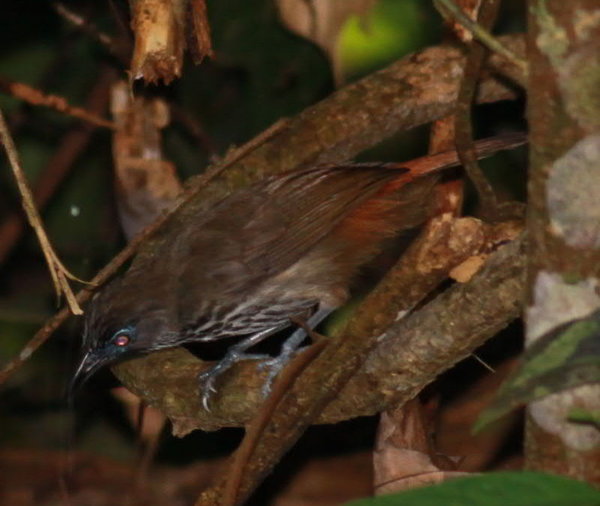
Actually I have shot this babbler before but lost my photo during migration to Blogspot umpteen years ago. This time we were lucky in our recent trip to Rompin forest reserve when a threesome came out to greet us in the middle storey as they responded to our callback.
Welcome to my Malaysian Birding Blog. My blog showcases my legacy of sightings of Malaysian bird in my lifetime - the countdown to 688 species and beyond. Actual numbers of birds you can see in Malaysia is more than 850 and adding.
Followers Do tag here to follow my latest posting
MikeBirder - Malaysian Birds
Welcome to my Malaysian Birding Blog. I migrated to blogspot.com as my blog at multiply.com closed shop in 2012. I wish to showcase all Malaysian birds that I have photographed whether here or overseas. My countdown of lifers started in 2005. Coming to March 2026 my countdown of lifers photograph has reached
595/688 species of birds of Malaysia in photos.
My shooting gear was a EF400mm f4 DO lens and Canon 7D body which to me is the ideal setup for mobility and bird chasing at that time. Eventhen the weight over my shoulder is more that 5.5 kg. As of June 2016 I have also acquired a Fuji XF 100-400mm OIS lens to complement my travelling cum birding trip overseas. My Fuji X-T2 went kaput recently and I upgraded to the X-T5 in 2023 ; the weight over my shoulder is much lighter now by 30%. In December 2018 I acquired the Nikon Coolpix P1000 as supplementary camera for distance shooting of 3000mm.
I am a weekend birder. Do feel free to drop me a line at mikebirding@gmail.com and I see whether you can tag along in my outings. My usual day trip is just an hour ride away to Hulu Langat, Lancang, Kemensah, Krau, Awana, Hulu Kali, Gombak Ole Road, Fraser's Hill , Bukit Tinggi and KSNP & Coastal Sg Janggut Jeram side of the coast . Overnite trip to Merapoh & Amp; Cameron, Air Hitam and further north to Kuala Sidim is a seldom affair but for lifer we travel. Panti in Johor is another good birding site that I yet to go. Then there are the Borneo birds of Sabah and Sarawak of Malaysia which I seriously much go to chalk up more lifers. This I did in 2018 to Sepilok Sandakan and Kinabalu Park. Next Danum and LahatDatu . In 2024 I visited a new happening birding spot in Talang Seremban.......
WARNING Birding is an addiction once you started its hard to stop. The wifey and children are now birding widow and orphan.
Translate
Search for Malaysian Bird Photos
Sunday, 28 September 2025
Babbler 19/23 - Scaly-crowned Babbler (New 579/688)
Actually I have shot this babbler before but lost my photo during migration to Blogspot umpteen years ago. This time we were lucky in our recent trip to Rompin forest reserve when a threesome came out to greet us in the middle storey as they responded to our callback.
Saturday, 23 August 2025
Babbler (18/23) - Grey-breasted Babbler Lifer 2025 (578/688)
ID - It is a small to medium-sized bird of 12-15cm. It has Gray-breasted plumage as its name with distinct white throat and underparts. Bill is Slightly curved and slender, suitable for insectivorous diet. Eye color is Dark eyes, often appearing bold whote lore and black face. – Wing and tail: Shorter wings and a relatively long tail, which is often held downward. Typically found in pairs or small groups, often foraging in leaf litter or low shrubs in dense undergrowth in humid forests or secondary growth areas. It produces a series of soft, melodious notes; listen for its distinctive vocalization.
![]() |
| Photo courtesy of AT |
![]() |
| Photo courtesy of ML |
Like many other babblers they respond to your bird call but this bird was a bit skittish in our encounter as there too many distraction from other birders also seeking the bird. It is known to mimic the calls of other bird species, which can sometimes confuse predators!
We got just a window of 20 second or so to shoot in the early morning lighting. My Fuji XT5 failed me as it was not focussing well enough in the low like condition. There were a family of 3 birds we saw during this post nesting period in July. It's mimic unique hopping manner and perch on vertical stump branches like forest Wren babbler showcasing their agility and adaptability.
Thursday, 24 November 2022
Babbler 23/27 (Bornean Endemic) Oct2022 - Bornean Black-capped Babbler
Here again there is a split in species, but I am not considering as a lifer. The Bornean bird is a distinct thickset brown babbler with a darker crown, an orange breast, and a bright white throat. North Bornean subspecies has a dark face and thin white eyebrows, absent elsewhere. Scurries about on the forest floor like a rodent, rummaging through leaf litter, either singly or in pairs. Found in lowland and foothill forests. Gives a high, piercing “tse-lee” somewhat akin to nails scratching across a blackboard.
Thursday, 10 November 2022
Babbler (17/23) Bornean -Temminck's Babbler (Lifer 560/688)
This was a side show bird but nevertheless my lifer to while we waited for the star bird namely Bulwer's Pheasant.
A very plain/drab babbler in colors but the recognisable streaking grey head define this small babbler. It is a babbler of lowland and foothill forests. Can be difficult to see in the shadowy forest floor and dense undergrowth it often forages in; listen for its song, a repetitive series of descending notes: “wi’DEW, wi’DEW!” Calls include a nasal, rising trill. If seen, note the overall warm brown body, white throat, and dark crown. Face color varies, ranging from gray to cinnamon-brown.
Temminck's babbler (Pellorneum pyrrogenys) is a species of bird in the family Pellorneidae. It is found in Borneo and Java. Its natural habitat is subtropical or tropical moist lowland forest.
This bird's common name commemorates the Dutch naturalist Coenraad Jacob Temminck. (Wiki)
Friday, 19 October 2012
BABBLER 22/23 - Abbott's Babbler
During my encounter it stays in one tree for a long period of half an hour. Unlike other babblers it tend to sit out on open branches. It continuous give out a three syllable clear sharp call which I recorded .....will attach later. Occasionally It will drop onto the ground and slowly climb up the tree upto 15 ft high. You notice the photos are top up. The bird was on its own. No mate yet for the breeding season. Apparently the nesting period of Abbott's Babbler can starts as early in late January until September as recorded in Thailand. Can also be sighted in KSNP and Taman Negara
The Abbott's Babbler (Malacocincla abbotti) is a SEA bird in the Timaliidae family as it is found in Bangladesh, Bhutan, Cambodia, India, Indonesia, Laos, Malaysia, Myanmar, Nepal, Singapore, Thailand, and Vietnam.
The name of the species commemorates William Louis Abbott (1860-1936), American naturalist and collector, who studied the wildlife of the Indo-Malayan region.
BABBLER 20/23 - Puff-throated Babbler
The Puff-throated Babbler or Spotted Babbler
is a species of passerine bird found in Asian region with population variations
has led to nearly thirty subspecies being described. In Malaysia it is found in
the northern peninsula from Perak upto Perlis. They are found in scrub and
moist forest mainly upto 1,800m of hilly regions. It can be heard and seen at
plantation fringes. I got my lifer near a rubber estate enroute to Bukit Wang
forest reserve. For the matter I got detoured from NS highway exiting early to
Kuala Nerang. Then heard the familiar loud and distinct call of the BTB whilst
slowing down at a T-junction. It took me almost an hour to locate one of them.
Just lucky it turn out that way. Puff-throated Babblers vocalize often. Their calls are a series of whistling notes ascending in scale - the common call "wi-chu" or "wi-ti -chu" The calling can be persistent. Their repetiore include their morning song, contact and alarm calls so you should have the right playback to lure it out from the undergrowth.
They are gregarious and forage in small groups on the forest floor, turning around leaf litter to find their prey and usually staying low in the undergrowth where they can be hard to spot. Puff-throated Babblers have strong legs, and spend a lot of time on the forest floor. They have weak flight because of their rounded short wings. They can often be seen creeping through undergrowth in search of their insect food, looking at first glance like a Song Thrush. It is considered a common babbler in peninsula.
The breeding season is mainly during the rainy season. They build a nest on the ground at the base of bush and is a dome of leaves and twigs with an entrance on the side. The opening usually pointing downhill when the nest is on slopy ground. The clutch varies from 2 to 5 eggs, with northern populations tending towards larger clutches. Parent birds run rodent-like in the undergrowth as they move in and out of the nest. Young birds fledge and leave the nest about 12 to 13 days after hatching.
Other recorded sighting is at Gunung Jerai Kulim and Kuala Kangsar. Just listen for its call.......good luck. I now need to find my last babbler Grey-breasted Babbler...................
BABBLER 21/23 - Grey-throated Babbler
The Grey-Throated is no exception when I encountered it together with the Dark-necked Tailorbird at Awana. Jason id it in an instant of its streaky forehead and grey with white patch throat. Size slightly bigger than the tailorbird....5 inches or so and keep to the lower storey
BABBLER 19/23 - Chestnut-rumped Babbler
It got this blue spectacle rim and black straited breast which is very distinct. And of cos the rump and tail is chestnut in colour. You also will notice its eyes are pale yellow
Thursday, 18 October 2012
BABBLER 18/243 - Black-capped Babbler
New photos taken at Merapoh Taman Negara in May2015 . Courting underway as the Male offering mealworms which other birders scattered at the feeding station.
BABBLER 17/23 - Black-throated Babbler
I must say it is a beautiful crooner like the fluffy-backed tit babbler. I got a video but blurred out.... sigh. This pair accompanied me for a good stretch of the trail but keep to the undergrowth. No clear shots but I am happy with what I got.
Its features are very distinct with white patches to cheek and brow. Its crown is also streaked. Dark throated with a white neck lace across its chest. Size wise just about 6 inches or 15cm. They start breeding in the months of May-July of the year. They are lowland birds keeping to evergreen and swampy forest upto about 500m sea level. Black-throated Babblers do comes down to lower storey to feed on grubs and invertebrates, berries and fruits as well as nectar when food are wanting.
Now to get Puff-throated in Gunung Jerai; Scaly-crowned & White-necked in Tmn Negara.
Revisited Bukit Rengit in June 2016 and manged some better shots of the bird as below;-
BABBLER 16/23 - Buff-breasted Babbler
| Latest Catch June2016 Jelai Frasers Hill |
The Buff-breasted Babbler (Trichastoma tickelli) is a species of bird in the Timaliidae family. Small about 14cm or 5.5inches in length. The matured bird will have fine black streak buff breast. My shots were a bit soft due to poor lighting. The Juve was without a tail and I earlier thought it was a Short-tailed Bab. It call out in response to my Large Wren playback. The Chestnut-winged also was calling nearby. It stayed mainly at the lower storey of the jungle. It's diet is mainly insects and grubs that they find on ground and low shrubs' branches.
It is found in Bangladesh, Cambodia, China, India, Laos, Malaysia, Myanmar, Thailand, and Vietnam. Its natural habitats are subtropical or tropical moist lowland forests (Krau, Panti) and moist montane forests upto 1,500m (like Fraser's). They usually start breeding and nesting in the months of Feb-Jul. their nest is cuplike and often on the ground under foliage or branches just 1.5 ft from the ground. Should be easy to find..................?
BABBLER 15/23 - Chestnut-winged Babbler
It is a beautiful babbler with bluish eye patch and grey chested and chestnut crowned.
Babblers tends to sulk behind thick the undergrowth. The only way to hold their attention is to call to them. Their curiosity and territorial habits will lure them out to some pocket opening for you to photograph them. Frequently in pairs. Breeding all year round. I can only manage some blurry shots here.
If you can notice the whitish patch of its cheek. It displaying in response to imitations of its voice. It approached the source of their call as close as 6 feet, You can notice it turned head-on and slowly bowed, tipping its bill to the ground whilst at the same time broadly expanding its chest to exhibit an almost iridescent halo of brilliant bluish white cheek which can be called the bellow flaps. The bird slowly bowing and expanding its breast, then raising its head once like a cuckoo dove. Territorial call I would say by this pair. during my encounter they were flying in circle around the source of sound and me several few times.
BABBLER 14/23 - Ferruginuous Babbler

Ferruginous Babbler is a bird of lowland forest not exceeding 200m sea
level. A very tough bird to see as they avoid human contact and have no
melodious call. They are wary of people and they prefer foraging to the middle
storey of the forest and peering from behind foliages. It is aptly called ferruginous because of its beautiful uniform bright brown coat. You will notice its slender long beak and light lore to the eyes. Mind my lifer photo which is out of focus........the damn bird cannot hold still. Size is about 16-18cm which is large for a babbler. This is because it has a flattened long tail and beak.
BABBLER 13/23 - Fluffy-backed Babbler
Found in lowland broadleaved forest fringes. hiding behind dark undergrowth and low shrubs. Do come out into forest opening fringe and pathway to grab for grubs and crawlies and quickly back into the bushes before you can shoot it. They do take berries and nectar
Size about 16-17cm. Overall brownish and rufous crown in color. black throated and bluish spectacle. It gives a variety of call and at time creaking quack sound- like. Breeding from month of Mar - Jun and their nest is on low shrubs and palms
BABBLER 12/23 - Golden Babbler
A birdwave is a obvious noisy affair of rainforest.This phenomenon where many different species band together and move rapidly though the forest, stirring up insects and feeding on them. Some tagged along on the way as the group gather strength & momentum.
Birdwaves occur at all storeys in the forest especially in the early morning and after overnight rainfall when there is a sudden surge of insects. Once you hear the cicadas and insects active again ........well you have missed the bird flypass
BABBLER 11/23 -Grey-headed Babbler
Then out pop this Grey-headed for me to snapped just a few shots ..............Madi was in the wrong angle so missed the chance. No worries we know where it is. Little is written of this bird and sighting is not common. It is found in lowland forest upto 1800m. Size is about 6 inches 14cm. Distinct white yellowish eyes gives it away with a silvery streaky grey head and neck. Whole body is chestnut in color.
Feed on a variety of food from insects, vertabrae, berries and nectar. They breed in the months of Feb-Aug; building their nest on the ground like anthill with a side opening in dense belukar or in the river banks. 2-5 eggs are laid at one time.
Very nice voice which sounded like "Chit Tiwieu Weet"
Tuesday, 16 October 2012
BABBLER 10/23 - Horsfield's Babbler
It says Horsfield's looks like the Abbott's in books . The differences is the darker crown color and the paler eye lores. Bodywise its more off white greyish with less rufous tinge. Its smaller at 15.5cm/ 6 inches. Anyway both are lowland babblers below 700m but Abbott's strives in all kind of terrains whilst Horsfield is found mainly near wet and water stream areas.