Welcome to my Malaysian Birding Blog. My blog showcases my legacy of sightings of Malaysian bird in my lifetime - the countdown to 688 species and beyond. Actual numbers of birds you can see in Malaysia is more than 850 and adding.
Followers Do tag here to follow my latest posting
MikeBirder - Malaysian Birds
Hi
Welcome to my Malaysian Birding Blog. I migrated to blogspot.com as my blog at multiply.com closed shop in 2012. I wish to showcase all Malaysian birds that I have photographed whether here or overseas. My countdown of lifers started in 2005. Coming into October 2026 my countdown of lifers photograph has reached
My shooting gear was a EF400mm f4 DO lens and Canon 7D body which to me is the ideal setup for mobility and bird chasing at that time. Eventhen the weight over my shoulder is more that 5.5 kg. As of June 2016 I have also acquired a Fuji XF 100-400mm OIS lens to complement my travelling cum birding trip overseas. My Fuji X-T2 went kaput recently and I upgraded to the X-T5 in 2023 ; the weight over my shoulder is much lighter now by 30%. In December 2018 I acquired the Nikon Coolpix P1000 as supplementary camera for distance shooting of 3000mm.
Welcome to my Malaysian Birding Blog. I migrated to blogspot.com as my blog at multiply.com closed shop in 2012. I wish to showcase all Malaysian birds that I have photographed whether here or overseas. My countdown of lifers started in 2005. Coming into October 2026 my countdown of lifers photograph has reached
604/688 species of birds of Malaysia in photos.
My shooting gear was a EF400mm f4 DO lens and Canon 7D body which to me is the ideal setup for mobility and bird chasing at that time. Eventhen the weight over my shoulder is more that 5.5 kg. As of June 2016 I have also acquired a Fuji XF 100-400mm OIS lens to complement my travelling cum birding trip overseas. My Fuji X-T2 went kaput recently and I upgraded to the X-T5 in 2023 ; the weight over my shoulder is much lighter now by 30%. In December 2018 I acquired the Nikon Coolpix P1000 as supplementary camera for distance shooting of 3000mm.
Fuji have finally made available their new XF 200-600mm lens which I yet to decide to spend another RM10,000. As for Fuji body I will stop with X-T5 36megapixel ..........
I am a weekend birder. Do feel free to drop me a line at mikebirding@gmail.com and I see whether you can tag along in my outings. My usual day trip is just an hour ride away to Hulu Langat, Lancang, Kemensah, Krau, Awana, Hulu Kali, Gombak Ole Road, Fraser's Hill , Bukit Tinggi and KSNP & Coastal Sg Janggut Jeram side of the coast . Overnite trip to Merapoh & Amp; Cameron, Air Hitam and further north to Kuala Sidim is a seldom affair but for lifer we travel. Panti in Johor is another good birding site that I yet to go. Then there are the Borneo birds of Sabah and Sarawak of Malaysia which I seriously much go to chalk up more lifers. This I did in 2018 to Sepilok Sandakan and Kinabalu Park. Next Danum and LahatDatu . In 2024 I visited a new happening birding spot in Talang Seremban.......
WARNING Birding is an addiction once you started its hard to stop. The wifey and children are now birding widow and orphan.
I am a weekend birder. Do feel free to drop me a line at mikebirding@gmail.com and I see whether you can tag along in my outings. My usual day trip is just an hour ride away to Hulu Langat, Lancang, Kemensah, Krau, Awana, Hulu Kali, Gombak Ole Road, Fraser's Hill , Bukit Tinggi and KSNP & Coastal Sg Janggut Jeram side of the coast . Overnite trip to Merapoh & Amp; Cameron, Air Hitam and further north to Kuala Sidim is a seldom affair but for lifer we travel. Panti in Johor is another good birding site that I yet to go. Then there are the Borneo birds of Sabah and Sarawak of Malaysia which I seriously much go to chalk up more lifers. This I did in 2018 to Sepilok Sandakan and Kinabalu Park. Next Danum and LahatDatu . In 2024 I visited a new happening birding spot in Talang Seremban.......
WARNING Birding is an addiction once you started its hard to stop. The wifey and children are now birding widow and orphan.
ALL PHOTOS IN THIS BLOG ARE COPYRIGHT OF MIKEBIRDER. KINDLY SEEK PERMISSION FROM THE OWNER IF YOU want to use them for commercial purposes.
Translate
Search for Malaysian Bird Photos
Showing posts with label cuckoo. Show all posts
Wednesday, 18 December 2019
Avian sighting December 2019 - Little Bronze Cuckoo Ipoh
After the trip to Penang I return to my hometown. In my suburb open park there is a pair of resident Bronze Cuckoo that I often hear them call out in the morning. So just take out out my gear and play it call and as usual they will response and drop by for you to shoot but only for one session though.
In term of feature and color its red eyering is prominently its peculiarity. You may mistaken the female Violet cuckoo from the LBC without the eye-ring. So be very sure if not you may lose a lifer. I myself have yet to see female VC.
Sunday, 15 December 2019
Cuckoo 14/15 - Asian Emerald Cuckoo (lifer 528)
Yes Finally the cuckoo is in the basket!!! It was amazing find in Penang. I thought it will not stay long but when Den and ZF got it during the day before; I change plan to give it a try on the weekend with my family in tow. Earlier I was to stop at Langkap to catch Zhong's finds.
Upon arrival at 8.30am many people were already patiently waiting for its appearance. Normally it lands high up in a particularly tree (apparently there were hairy caterpillars festing - Tussock moths caterpillars) next to a stream. First to get it as usual is Zhong and I was already hopeful its still around. Then after half an hour of waiting patiently one of the fellow birder shouted across the stream that the bird is there. There were hysteria rush to the spot . Can you imagine the excitement when 15 of us running with the youngest one a 11 year ole with her P900 I think.
Took off my sandal to cross the sandy stream as it was the shortest route to be one of the first on the spot whilst the others took the bridge. I was ecstatic to sight the bird high up a bamboo outcrop almost vertically for the first time in my life. As usual record shots were taken as proof of lifer no matter how high.
So it was a merry chase around the open ground for a good 15-30 minutes as the guys shoot to their heart content. It did come down as low as 20 ft where many of us got the above shots. Within an hour of the encounter. I left the vicinity to go makan-makan and visiting Penang with my family. The nearest stop was Pulau Tikus market for their street food and local delicacies.
This cuckoo was previous reported seen by Dr Amar in Tambun who never share his finding about 2 years back I think. This fellow have his own reason and bird ethic for not sharing or divulge its locale......... so do not vilify him..............For my lifer : thanks Capt for your tip off.
They breed in Himalaya Myammar Northen Thailand till China but not in Malaysia. If there is a pair I believe we may see a brood in Penang liao. Cuckoo is a brood parasite, its been recorded the females lay their eggs in the nests of other birds, such as the crimson sunbird (Aethopyga siparaja) and the little spiderhunter (Arachnothera longirostra). They usually found at forest fringes amongst fruiting orchards or garden suburbs where there is plenty of caterpillars. During our encounter here it was seen sallying for flying insects.


The Asian emerald cuckoo mainly forages in the upper levels of the canopy where it feeds on insects and other small
invertebrates, including ants, caterpillars and bugs.
The Asian emerald cuckoo grows to a length of about 7 inches. The adult male has an iridescent dark green head, upper parts and upper breast, a white lower breast and a green barred belly. Bare skin round the eye is orange and the beak is orange/yellow tipped with black. The adult female has coppery-green upper parts, rusty brown crown and nape and green-barred underparts. Both sexes show a white band on the underwing when in flight. The underparts of the juvenile male lack the white lower breast and are more heavily barred. The voice is a “chweek” uttered while flying, and various whistled twitters.
The crowd of birders from near and far were there chasing this tiny little bird. The cuckoo do not looked stressed by the attention given by us birders while it was hunting for flying insects.
On Sunday after; it was reported that a male cuckoo also showed up and guess who was there......Zhong; he really got the bird luck and perseverance Never in my mind that there is a pair there, I think it is not too late for other birders to try out their luck to see this wonderful bird in Malaysia.
BIRD LUCK TO YOU!!!
Upon arrival at 8.30am many people were already patiently waiting for its appearance. Normally it lands high up in a particularly tree (apparently there were hairy caterpillars festing - Tussock moths caterpillars) next to a stream. First to get it as usual is Zhong and I was already hopeful its still around. Then after half an hour of waiting patiently one of the fellow birder shouted across the stream that the bird is there. There were hysteria rush to the spot . Can you imagine the excitement when 15 of us running with the youngest one a 11 year ole with her P900 I think.
Took off my sandal to cross the sandy stream as it was the shortest route to be one of the first on the spot whilst the others took the bridge. I was ecstatic to sight the bird high up a bamboo outcrop almost vertically for the first time in my life. As usual record shots were taken as proof of lifer no matter how high.
So it was a merry chase around the open ground for a good 15-30 minutes as the guys shoot to their heart content. It did come down as low as 20 ft where many of us got the above shots. Within an hour of the encounter. I left the vicinity to go makan-makan and visiting Penang with my family. The nearest stop was Pulau Tikus market for their street food and local delicacies.
This cuckoo was previous reported seen by Dr Amar in Tambun who never share his finding about 2 years back I think. This fellow have his own reason and bird ethic for not sharing or divulge its locale......... so do not vilify him..............For my lifer : thanks Capt for your tip off.
They breed in Himalaya Myammar Northen Thailand till China but not in Malaysia. If there is a pair I believe we may see a brood in Penang liao. Cuckoo is a brood parasite, its been recorded the females lay their eggs in the nests of other birds, such as the crimson sunbird (Aethopyga siparaja) and the little spiderhunter (Arachnothera longirostra). They usually found at forest fringes amongst fruiting orchards or garden suburbs where there is plenty of caterpillars. During our encounter here it was seen sallying for flying insects.


The Asian emerald cuckoo mainly forages in the upper levels of the canopy where it feeds on insects and other small
invertebrates, including ants, caterpillars and bugs.
The Asian emerald cuckoo grows to a length of about 7 inches. The adult male has an iridescent dark green head, upper parts and upper breast, a white lower breast and a green barred belly. Bare skin round the eye is orange and the beak is orange/yellow tipped with black. The adult female has coppery-green upper parts, rusty brown crown and nape and green-barred underparts. Both sexes show a white band on the underwing when in flight. The underparts of the juvenile male lack the white lower breast and are more heavily barred. The voice is a “chweek” uttered while flying, and various whistled twitters.
The crowd of birders from near and far were there chasing this tiny little bird. The cuckoo do not looked stressed by the attention given by us birders while it was hunting for flying insects.
On Sunday after; it was reported that a male cuckoo also showed up and guess who was there......Zhong; he really got the bird luck and perseverance Never in my mind that there is a pair there, I think it is not too late for other birders to try out their luck to see this wonderful bird in Malaysia.
BIRD LUCK TO YOU!!!
Sunday, 10 July 2016
CUCKOO 13/15 - Rusty-breasted Cuckoo
I realised I yet to post it from my library of birds. In any case I got the opportunity to shoot the bird again in Ipoh with my good Ipoh friends Lean, Ooi and new acquintaint John. This is a resident bird in Malaysia as well as southern Thailand Singapore and Phillipines and Indonesia. It is less common seen than the Plaintive Cuckoo.
| This is an adult male whilst the female have a bit of barring to its chest |
The cuckoo looks almost alike its cousin the Plaintive but if you start comparing you will see
1. Both have yellow eye-ring but the Rusty have more distinctive yellow eye-ring.
2. Grey top from head to the upperparts for the plaintivie whilst the Rusty has a rusty creamy front from its chests to its underpart.
3. One is often seen perch in open plain and suburbs garden areas and the other prefers in jungle fringe in shady tree canopy.
4. The Plaintive is rather quiet in nature whilst the Rusty-breasted is most vocal in its territorial calls
5. Size wise the Plaintive is much slimmer and the Rusty is a cm longer and bigger.
Friday, 19 June 2015
CUCKOO 12/14 - Horsfield's Bronze Cuckoo
I like to thank fellow MNS birders Andy & Ang for their guidance in my search of this lifer of mine . As you can see in my first photo there are 2 of them!!! at the site in Kuala Selangor Jeram side. One was with white eye and the other has reddish one. This will be my second lifer of the year of 2015.
The HB Cuckoo looks almost the same as our resident - Little Bronze Cuckoo except that it has a more prominent brown eye stripe ala the Banded Bay and without the red eye-ring of the latter. Size wise they are the same at 6 inches or 15-16cm.
The Horsfield’s Bronze-cuckoo is common throughout Australia preferring the drier open woodlands away from forested areas. It is a rare visitor/ vagrant to Peninsula (ie. a bird that strays off its typical migration course because of strong winds, which in this case, has blown it beyond the Indonesian islands during the austral winter (ie. May, June, July and August), from Australia to Indonesia. So now this cuckoo can be seen from Singapore to Pulau Burung Seberang Prai. I am sure there are plenty of HB cuckoo along the coastal plains of peninsula Malaysia ..........its a matter of going out to explore and search for it... a record year for 2015. Look for Mimosa vegetation in the open land which they make it their playground. Cuckoos have a common habit of impaling their preys on thorny plants. They usually hunt for hairy caterpillars amongst the lower ground shrubland. Next is to see any of Perak birders to report from their side. Koay what say u. BTW Madi fellow birder from KL(http://madibirder.blogspot.com) did sight one as far as in the coastal side of Bukit Keluang Trengganu in 2012.
Now is to wait for a Sacred Kingfisher to drop by .........fat hope you'll say.
Labels:
cuckoo
Location:
Kuala Selangor, Selangor, Malaysia
Sunday, 11 August 2013
CUCKOO 11/14 - Little Bronze Cuckoo
Little Bronze Cuckoo
The Little Bronze Cuckoo (Chrysococcyx minutillus) is a species of cuckoo in the Cuculidae family.It is found in Australia, Cambodia, Indonesia, Malaysia, Papua New Guinea, Singapore, Thailand, and Vietnam. This make my 11th cuckoo lifer. The other 3 cuckoos that I wanted are Horsfield's Bronze , Emerald and the Moustached Hawk will be my tougher targets as the former two are vagrant birds. Madi got the Horsfield's in East coast last year what luck!
This is the world's smallest cuckoo, coming in at 15 cm (6 in). The most telling feature of the little bronze is its red eye ring and beautiful black barring to its front. It has metallic greenish bronze wings. 
However the immature bird can be mistaken for the horsfield's with its forehead and faint eyestripe pale greyish-brown. Chin, throat and upper breast greyish-brown, with no barring. Remaining underparts almost entirely white washed with grey, without any barring though, sometimes, the feathers may be tipped darker
Its natural habitat is subtropical or tropical moist lowland forests. In peninsula Malaysia it more often seen in coastal forest but it can be seen in suburb parks. My sighting is in Ipoh town itself near my family home. It appears that it is a resident at this nearby park as I have seen it last year but no photo as yet then. This time played its call and within the hour it pop out from nowhere. This happened on 2 consecutive morning. Met Bob and Farah from down under who are staying nearby here on "my 2nd home" programme just guessing. They are MNS Perak members now .Its call is a four-note whistle, the first note long, the next two short, the fourth note sometimes rather longer and drawn out: the whole a melancholy cadence, the notes not quick and regular but slow, uneven, and sounding as though uttered with an effort describes it as a descending call of 3 to 5 thin, tremulous notes, teu, teu, teu, teu, also a high-pitched, drawn-out trill on a descending scale.
A commonly heard call, very like that described by Robinson & Chasen, consists of four high-pitched whistling notes, uttered very fast, the entire sequence lasting just over one second, chi-chi-chi-chew, with a very slight pause immediately before the last note which is longer and on a downward scale. This call is quite variable, sometimes starting with two or three softer chit notes, followed by three louder chi-chi-chi notes and ending with a short downward chit and a random series of soft chit notes.

They take their prey from foliage and from the ground. Mainly insectivorous, their food seems to consist mainly of beetles and caterpillars of species such as butterflies and moths. The bird rubs hairy caterpillars against the perch to get rid it of the numerous hairs.
It has a rather indirect dipping flight like bulbuls and it often calls from the tops of trees.
The Little Bronze Cuckoo is bit of a specialist, and victimises only birds from the genus Gerygone. The local race, peninsularis, victimises the Golden-bellied Gerygone which is a common garden bird and coastal forest.
Again It is said a very common cuckoo and can be found in small numbers, mostly in parks, wooded gardens, orchards, overgrown plantations, open areas with scattered trees, secondary scrub, mangroves and along the forest edge, but never in dense primary forests. It has also been recorded in thickets of Melastoma . More gregarious and lively than the Violet Cuckoo , it is usually seen flying from one place to another or joining mixed hunting parties .......It took me 8 years to shot it though.............
Monday, 29 October 2012
CUCKOO 10/14 - Drongo Cuckoo (Square-tailed)
Drongo Cuckoo
Aptly called "drongo" cuckoo I
think because of the similarity of its same shape & slender tail. Slightly
larger than a pigeon. Can compare with a Bronze Drongo later. The glossy bluish
feathers are almost the same. Only difference is in the shape of the beak and
head features. You wonder it a mixed breed..........
They are very approachable and not easily spooked unless you move exaggerately. They are curious bugger too and will come 20-25 feet. near u which I did encounter the specie at ISI Rimba site in Kemensah last week.
| Capture at Langkap-Ipoh Talang Nov2024 |
CUCKOO 9/14 - Banded Bay Cuckoo
Found in broadleaved forest in open area. Just have to call them in. Surprisingly this is a resident of Malaysia but can be found in open parkland in the city and suburbs.
CUCKOO 8/14 - Chestnut-winged Cuckoo
Chestnut-winged Cuckoo
This is a migrant Cuckoo to our jungle in Peninsula Malaysia. As usual Cuckoo are
easier to photog as they frequent low vegetation and do come out in the open to
look for insects. In fact the rainy season is the best period to see them.
This is a large size cuckoo as long as 41cm or 18 inches. This is the only Cuckoo that has a crested head that you can see in here. Thailand's also have a vagrant Pied Cuckoo that has a crest too. You never know one will just extend its visit down to Peninsula.
CUCKOO 7/14 - Hodgson's Hawk Cuckoo
Hodgson's Hawk Cuckoo
The splitting of subspecies of the migratory
Hodgson's Hawk Cuckoo (HHC) and Malaysian Hawk Cuckoo (MHC) has caused much
confusion amongst birdwatchers in Peninsula Malaysia. Actually the differences
is there when comparing mature adult birds. It is only when you want to id the
immature or subadult HHC based on poor photos like mine here.Yong Ding Li did a superb writeup on the differences of features of the birds. For the adult bird; the easy tell tale is that the HHC has rufous wash on its neck to breast (like the Large Hawk Cuckoo) whilst the MHC has a cleaner and heavy vertical streaking. The MHC also have more puffy white throat to go; see my shot at : http://mikebirder.multiply.com/photos/album/436/Cuckoo_Malaysian_Hawk_#
A summary of visible immature features between the species are as follows:
Immature Features Comparison
a. White nape patch MCC - Present / HHC - Absent
b. Wings Fringes MCC - Pale whitish & faint / HHC - Buffy to Rusty
c. Innermost Tertial feathers MCC - More Brownish / HCC - Paler & very faint
d. Bands on underside primaries MCC - broader / HHC - Less broad
e. Underparts MCC - Whiter & cleaner / HHC Rufous orangy wash
f. Plumage Color MCC - Darker Brown / HHC lighter and true brown
Further to that timing of sighting of the HHC should be during the period between the coming of northern wintering period initiate the migratory period starting as early as October and the arrival of Spring/Summer call for the return trip back to northern hemisphere as late as May of the year. Another fact is according to Craig Robson's bird guide MHC is a resident lowland bird and seldom go higher than 500m whilst the HHC prefers the cooler coastal lowland to highland upto 1500m.
CUCKOO 6/14 - Large Hawk Cuckoo
Large Hawk Cuckoo
Still hunting for my elusive Speckled Piculet
last weekend in the month Oct 2011. Instead got 2 lifers. One of them is this
large bird of 15 inches or 40cm at the Telekom loop left of the junction.
Large Hawk Cuckoo is found in Bangladesh, Bhutan, Cambodia, China, India, Indonesia, Laos, Malaysia, Myanmar, Nepal, Pakistan, the Philippines, Singapore, Taiwan, Thailand, and Vietnam. The resident subspecies of the Malay Peninsula, Sumatra and Borneo is sometimes considered a separate species, the Dark Hawk-cuckoo (C. s. bocki ). It feeds on insects, mainly caterpillars, spiders, birds eggs and berries. In Peninsula they can be seen at highland tropical forests at altitude upto 2,500m like Fraser's Hill. LHC can also be seen in Awana side but may be the migrant ones.
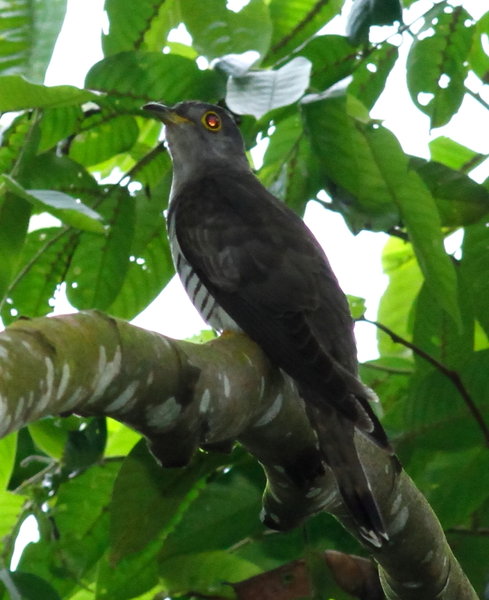
It has a greyish-brown back, a grey head and a tail with broad bars. The throat is white and the breast is rufous and both have dark streaks. The belly has broad black bands on white. The eyering is yellow and the iris is orange to buff in colour.
It is a brood parasite and its hosts tend to be Laughingthrush, Barwings and similar. Its scientific specific name sparverioides means "resembling a Sparrowhawk" and, in flight, it looks just like a Sparrowhawk. It is possible that this may cause potential hosts to flee allowing the Large Hawk-cuckoo to lay its eggs.
Still hunting for my elusive Speckled Piculet
last weekend in the month Oct 2011. Instead got 2 lifers. One of them is this
large bird of 15 inches or 40cm at the Telekom loop left of the junction.Large Hawk Cuckoo is found in Bangladesh, Bhutan, Cambodia, China, India, Indonesia, Laos, Malaysia, Myanmar, Nepal, Pakistan, the Philippines, Singapore, Taiwan, Thailand, and Vietnam. The resident subspecies of the Malay Peninsula, Sumatra and Borneo is sometimes considered a separate species, the Dark Hawk-cuckoo (C. s. bocki ). It feeds on insects, mainly caterpillars, spiders, birds eggs and berries. In Peninsula they can be seen at highland tropical forests at altitude upto 2,500m like Fraser's Hill. LHC can also be seen in Awana side but may be the migrant ones.
It has a greyish-brown back, a grey head and a tail with broad bars. The throat is white and the breast is rufous and both have dark streaks. The belly has broad black bands on white. The eyering is yellow and the iris is orange to buff in colour.
It is a brood parasite and its hosts tend to be Laughingthrush, Barwings and similar. Its scientific specific name sparverioides means "resembling a Sparrowhawk" and, in flight, it looks just like a Sparrowhawk. It is possible that this may cause potential hosts to flee allowing the Large Hawk-cuckoo to lay its eggs.
CUCKOO 5/14 - Malaysian Hawk Cuckoo
Malaysian Hawk Cuckoo
This is a resident of Malaysia wherelse there is another subspecies Hodgson's Hawk Cuckoo which winter over here from China - Nepal side. Similar in size and shape. The separation is the Malaysian has a cleaner black streak marking over whitish chest whilst the visitor have buffy rustic chest and the latter have darker grey overall. Both have a bit of puff throat and flatten tail. Calls is almost the same. During the same time of my sighting a Hodgson's was sighted in Singapore. Very rare to see the latter......
It is a medium size cuckoo reaching less that a foot with a flattened out tail.
CUCKOO 4/14 - Oriental Cuckoo
Caught it in FRIM Kepong during a rainy
morning. With its greyish coat and clear barred white chest The Indian Cuckoo
have a more brownish and distinct coat.
CUCKOO 3/14 - Plaintive Cuckoo
The Plaintiff frequent the open ground and
perched on dead stumps, post and fences on lowland and jungle fringes. The
closest u can approach them is about 30-40 ft if you walk slowly and zig
zagging to it. They will just fly off to a similar distance from where you
started off.
It is the size of a pigeon with a greying head, red eyed with a beautiful tail and chestnut winged. Last seen in TRA. It is seasonal traveller and not local to an area.
Friday, 5 October 2012
CUCKOO 2/14 - Indian Cuckoo
Indian Cuckoo
The Indian Cuckoo is a brood parasite. It lays its single egg mostly in the nests of drongos and crows. It removes and eats an egg from the host nest before laying its own. The breeding season varies from May to July in northern China, March to August in India, January to June in Burma and January to August in the Malay Peninsula. This is a medium sized cuckoo with both sexes alike. It has grey upperparts while the underside has broad black barring. The tail is barred with a broad subterminal dark band and a white tip. Young birds have white markings on the crown and white chin and throat contrasting with a dark face. Juveniles are browner and have broad white tips to the head and wing feathers. The eye-ring is gray to yellow (a feature shared with the Common Hawk-Cuckoo). The iris is light brown to reddish. The female differs from the male in being slightly paler grey on the throat and in having more brown on the breast and tail. The barring on the belly is narrower than in the male. Nestlings have an orange-red mouth and yellow flanges to the gape.
The call is loud with four notes. They have been transcribed as "orange-pekoe", "bo-ko-ta-ko", "crossword puzzle" or "one more bottle". In Bengali, it is interpreted as "bou-kotha-kao", "Bride, please speak". Very little variation is noted between regions although the song in China is said to rise at the end. In the Kangra Valley of India, the call is interpreted as the soul of the dead shepherd uttering "where is my sheep". In China, one of the names ( means "four-note cuckoo". They are locally common in the breeding season with as many as a calling bird for every 2 square km in northern India.
They feed on hairy caterpillars and other insects but sometimes take fruits. They usually feed on the upper canopy, gleaning insects, sometimes making aerial sallies for flying termites or rarely even by hovering lower near the ground.
Subscribe to:
Posts (Atom)