Welcome to my Malaysian Birding Blog. My blog showcases my legacy of sightings of Malaysian bird in my lifetime - the countdown to 688 species and beyond. Actual numbers of birds you can see in Malaysia is more than 850 and adding.
Followers Do tag here to follow my latest posting
MikeBirder - Malaysian Birds
Welcome to my Malaysian Birding Blog. I migrated to blogspot.com as my blog at multiply.com closed shop in 2012. I wish to showcase all Malaysian birds that I have photographed whether here or overseas. My countdown of lifers started in 2005. Coming into October 2026 my countdown of lifers photograph has reached
604/688 species of birds of Malaysia in photos.
My shooting gear was a EF400mm f4 DO lens and Canon 7D body which to me is the ideal setup for mobility and bird chasing at that time. Eventhen the weight over my shoulder is more that 5.5 kg. As of June 2016 I have also acquired a Fuji XF 100-400mm OIS lens to complement my travelling cum birding trip overseas. My Fuji X-T2 went kaput recently and I upgraded to the X-T5 in 2023 ; the weight over my shoulder is much lighter now by 30%. In December 2018 I acquired the Nikon Coolpix P1000 as supplementary camera for distance shooting of 3000mm.
I am a weekend birder. Do feel free to drop me a line at mikebirding@gmail.com and I see whether you can tag along in my outings. My usual day trip is just an hour ride away to Hulu Langat, Lancang, Kemensah, Krau, Awana, Hulu Kali, Gombak Ole Road, Fraser's Hill , Bukit Tinggi and KSNP & Coastal Sg Janggut Jeram side of the coast . Overnite trip to Merapoh & Amp; Cameron, Air Hitam and further north to Kuala Sidim is a seldom affair but for lifer we travel. Panti in Johor is another good birding site that I yet to go. Then there are the Borneo birds of Sabah and Sarawak of Malaysia which I seriously much go to chalk up more lifers. This I did in 2018 to Sepilok Sandakan and Kinabalu Park. Next Danum and LahatDatu . In 2024 I visited a new happening birding spot in Talang Seremban.......
WARNING Birding is an addiction once you started its hard to stop. The wifey and children are now birding widow and orphan.
Translate
Search for Malaysian Bird Photos
Tuesday, 6 October 2026
Avian Sighting October 2026 - Comb Duck @ Knob-billed
Friday, 14 April 2023
DUCK 12/15 - Sunda Teal (Lifer 573/688)
This is a medium size duck of upto 43cm; I always thought teal is small in size like grebe. The Sunda teal (Anas gibberifrons), also known as the Bebek cokelat or Itik benjut, is a dabbling duck found in open wetlands in Indonesia. The species formerly included the Andaman teal Anas albogularis and the grey teal, Anas gracilis as subspecies, but is currently considered monotypic.
Subki mentioned that they are breeding now in Tawau port; but he is afraid soon the abandoned fish ponds will reactivated and the manmade habitat may be disturbed. In the evening I only got to shoot a single duck. The following morning the duck was missing from the pond
By the way the Sunda Teal was not mentioned in my bird bible (CraigRobson) as a Malaysia bird.....
It is a dull, brown duck with ruby-red eyes. Also note rounded forehead with noticeable bulge and bright green-and-white wing patches. Found in freshwater, brackish, and occasionally marine habitats, forages primarily by dabbling. Typically moves in pairs or small groups.
Wednesday, 12 April 2023
DUCK 13/15 - Wandering Whistling Duck (Lifer 572/688) April 2023
In peninsula Malaysia we usually see the Lesser Whistling Duck but in Sabah waters the Wandering Whistling is easily seen at watersheds like flood retention pond, housing estate lakes and abandoned fish ponds. It is fortunate that there are not hunted by the town folks and they still propagate in abundance in man made habitat.
Breeding occurs during the tropical wet season usually between December and May. During this time six to fifteen eggs are laid in a nest not far from water and usually in high grass or a sheltered area.
Monday, 28 November 2022
Avian Post Nesting November 2022 - A dozen ducklings
It was a surprise sighting to see that this pair of Whistling Duck can have a dozen duckling. I believe they may be surrogate parents to other fledglings. Later we also sighted another pair of parents with about five duckling in another nearby canal in Sg Rambai. Looks like there is a bumper offspring here despite living amongst macaques and other predators like monitor lizards here.
Monday, 18 July 2022
Duck 7/15 - Knob-billed/African Comb Duck Lifer 551/688) June 2022
| Never good in BIF shooting Some times birders have two camera setup for handheld with ready BIF setting. Here I was not ready for that with my Fuji XT2. Just set to high speed on auto . |
The nearest breeding colony of Comb is in Thale Noi Southern Thailand. They say there is a 500 strong colony there. The bird seen here is likely an early arrival in late June and by the looks of it, the bird is an immature bird. Who know there will be more frequent sighting in the future.
| My pathetic BIF shot |
Comb is one of the largest species of duck. Length can range from 56 to 76 cm in length, wingspan ranges from 116 to 145 cm in and weight from 1.03 to 2.9 kg . Adults have a white head freckled with dark spots, and a pure white neck and underparts. The upperparts are glossy blue-black upperparts, with bluish and greenish iridescence especially prominent on the secondaries (lower arm feathers). The male is much larger than the female, and has a large black knob on the bill. Young birds are dull buff below and on the face and neck, with dull brown upperparts, top of the head and eyestripe. Knob-billed ducks are generally larger in size when compared to comb ducks, and flanks are usually lighter (light grey, in females sometimes whitish).
![]() |
| A Black Kite we capture in the morning ? |
Immature knob-billed ducks look like a large greyish female of the cotton pygmy goose (Nettapus coromandelicus) and may be difficult to tell apart if no other birds are around to compare size and hue. However, knob-billed ducks in immature plumage are rarely seen without adults nearby and thus they are usually easily identified too.
The knob-billed duck is silent except for a low croak when flushed.
Uncertainty surrounds the correct systematic placement of this species. Initially, it was placed in the dabbling duck subfamily Anatinae. Later, it was assigned to the "perching ducks", a paraphyletic assemblage of waterfowl most of which are intermediate between dabbling ducks and shelducks. As the "perching ducks" were split up, the knob-billed duck was moved to the Tadorninae or shelduck subfamily.
It breeds in still freshwater swamps and lakes in the tropics. It is largely resident, apart from dispersion in the wet season.
This duck feeds on vegetation by grazing or dabbling and to a lesser extent on small fish, invertebrates, and seeds. It can become a problem to rice farmers. Knob-billed ducks often perch in trees. They are typically seen in flocks, small in the wet season, up to 100 in the dry season. Sometimes they separate according to sex.
African birds breed during and after the rainy season and may not breed if the rain is scanty. Knob-billed ducks nest mainly in tree holes, also in tall grass. Males may have two mates at once or up to five in succession. They defend the females and young but not the nest sites.
Females lay 7 to 15 yellowish-white eggs.
Monday, 17 February 2020
DUCK 11/15 January 2020 - Spot-billed Duck (lifer 538)
I am never good in BIF shooting. Maybe its my Fuji XT-2; which is never meant to be for shooting birds in flight. In Ang Trapeang Thom most of the time you be shooting from the hip and from the sampan. Richard's OMD 1-X should do better on that day but I cannot say about Den's EF500mm heavy bazooka. I guess he can only watch. Sad. We agreed that bird watching or digiscoping is more suited in Siem Reap as the birds are way too far from us.Well a lifer is a lifer no matter how blur it is for me. My camera I think have some metering issue Even when I was shooting at 1/2000-4000. the pictures are not good in exposure and blur. Damn I really need to save up to convert to OLYMPUS...........
Friday, 24 February 2017
DUCK 10/15 - Northern Pintail
This dabbling duck breeds across northern areas of Eurasia south to about Poland and Mongolia, and in Canada Alaska and the midwest USA. Mainly migrating south of its breeding range during the northern hemisphere winter period Dec-March, reaching the equator.
Among the most handsome of all ducks, the northern pintail (Anas acuta) is recognised by its slender build, long, elegant neck and elongated, spiky central tail feathers, a feature that gives rise to its common name. A graceful waterbird with long, narrow wings, during the breeding season the male northern pintail has a chocolate-brown head, white underparts and a white neck, with a thin, white line extending up the back of the neck, and a long, black tail bordered by yellowish-tan patches. The upper back and sides are grey, the lower back feathers are black with pale edges, and the rear of the wing is bronze-greenish, with a black band and white rear edge. The eyes are dark brown and the legs are grey. At other times of the year, the male northern pintail has duller, brownish plumage, with fine, dark streaks on the neck and broad, dark barring on the upperparts. The female northern pintail lacks the colourful plumage of the male, with largely brown upperparts, a tan crown and face, whitish underparts, and a bronzy-greenish band on the rear of the wing, as well as bluish-grey legs and a dull black bill.
Walking or running with a slight waddle, the northern pintail is actually quite agile on land, but is most graceful and acrobatic in flight. It is able to achieve great speeds while flying, earning the species the nickname ‘greyhound of the air’ . The northern pintail is a rather quiet bird, but the male may emit a mellow, whistled “kwee” or “kwee-hee”, while the female produces a hoarse, muffled “quack”.
After seeing WaiMun's posting it was my turn to try my luck and with some guidance from my Ipoh sifu and MNS Perak folks the encounter begins.........
I reached the site a bit late in the morning at almost 9.00am from KL. There was nobody there in the weekday. From the car I scan the pond for more than 10 mins but could not spot the duck in the pond. I could only see little grebe and some whistling ducks. I was worried it may had left the scene; then there were some movement at the opposite bank and walla my lifer came into view and I was exuberating excited. The duck was preening itself for quite sometime as I quickly took some record shoots just in case. It has yet to go into the pond and I quickly mounted my gears and in I go to set up position at the right side of the pond. The MO is to stride crouching the ground and using the embankment to hide from its view. Almost halfway up the pondside I cannot go further as the duck was in view of me. I stop there in sitting position so that I am less intimidating and waited. Less than a minute the duck started out into the pond as it notice my position. It did not come close but swim keeping a constant distance. Then a buffalo cowherd on its motobike passes by the pond and it waddle into the middle of the pond and nearer toward me. What luck as I shoot away. Even then it was still far out. All pictures here heavily crop as I was shooting at about 200 ft out to the pond. I left about half an hour of shooting it as not to harass it so much. The end of my encounter............
Digiscoping at 1200-1600mm (3 x my 400mm set up) will yield beautiful feather features. Otherwise to shoot full frame detail photos you need to use a hide and set up as early as 6.30-7.00 am when its still dark and wait. I really cannot afford the time. I totally forgot to bring my broken Nikon P900 but usable if not I would have better pictures.
Thursday, 2 February 2017
DUCK 9/15 - Eurasian Wigeon
The above photo taken in Arashiyama Kyoto. A pair of the Wigeon leading another pair of Coot behind. Already in the late evening I did not take the effort to get better pictures did not know then it was malaysian lifer ....sign Later got some more photos in Osaka using my XF16-55mm for crying out loud as I left my telezoom at my guesthouse. There were many pairs around the moat of Osaka Castle. All heavily crop photos taken at a distance of 30 ft.
New sighting in 10 Jan 2020 of a Eurasian Wigeon at Pulau Burung Penang
Wednesday, 25 January 2017
DUCK 8/15 - Common Teal
Common Teal is recorded as a Vagrant to Malaysia.............So far there is no photo record sighting in Peninsula but we hope for the best in coming years after the Comb duck was sighted last December 2016 in Byram Penang.
This winter visitor , from northern Europe and Eastern Siberia is common to reach India rather than SEA where they flock on sheltered wetlands, jheels, marshes. Largely vegetarian they look for grains, shoots of rice, marsh plants and aquatic invertebrates in thick muddy areas.
Male is penciled greyish, chestnut head, broad metallic green band running backward from eye to nape. Tri-colored wing - black, green and buff. Female is mottled dark, light brown, pale underparts, black and green supercilium.
Size wise it is small duck at 38 cm about the same as the commoner cotton pygmy.

My take was in Kyoto Japan while holidaying in the month of December 2016
Tuesday, 22 December 2015
DUCK 7/15 - Mallard
Male Mallards (as in top picture) have a dark, iridescent-green head and bright yellow bill. The gray body is sandwiched between a brown breast and black rear. Females and juveniles are mottled brown with orange-and-brown bills. Both sexes have a white-bordered, blue “speculum” patch in the wing.
Mallards are “dabbling ducks”—they feed in the water by tipping forward and grazing on underwater plants. They almost never dive. They can be very tame ducks especially in city ponds, and often group together with other Mallards and other species of dabbling ducks.
Mallards can live in almost any wetland habitat, natural or artificial. They are monogamous and paired for life but the male do have "extra marital affairs" lol. Look for them on lakes, ponds, marshes, rivers, and coastal habitats, as well as city and suburban parks and residential backyards.
Sunday, 19 January 2014
DUCK 6/15 - Garganey
I missed the last year's sighting in Pulau Burung in 2013. Glad they returned and landed in Malim Nawar which 30 odd km from my Ipoh hometown. Thanks to Lean and wifey for their bird luck last weekend I got to get this pair of Garganey. They are migratory bird and consider rare visitor from Europe or West Asia. The usual ones are the cotton pygmy and the whistling duck. Seen flying in front is a more rarity - Northern Shoveler. Last year the Tufted Duck dropped in and I hope to see the Masked Finfoot some day in Malim Nawar soooon.
The adult male is unmistakable, with its brown head and breast with a broad white crescent over the eye. The rest of the plumage is grey, with loose grey scapular feathers It has a grey bill and legs. In flight it shows a pale blue speculum with a white border. When swimming it will show prominent white edges on its tertials. His crown (anatomy)is dark and face is reddish-brown.Sunday, 12 January 2014
DUCK 5/15 - Northern Shoveler
Lifer to start the new year of 2014. Have not been birding since December last year. So when news of some ducks have landed; enticed me to go out again. Thanks to my young sifu Tou and Davey again. This is a rare migrant bird to see. Apparently it is only the third record sighting in Peninsula. Considered as rare as the Masked Finfoot le. Glad that Lean and MSN Selangor was there last weekend to guide me around.
This species is unmistakable due to its large spatulated bill. The breeding drake has an iridescent dark green head, white breast and chestnut belly and flanks. In flight, pale blue forewing feathers are revealed, separated from the green speculum by a white border. In early fall the male will have a white crescent on each side of the face.In non-breeding (eclipse) plumage seen here, the drake resembles the female. The female is a drab mottled brown like other dabblers, with plumage much like a female Mallard, but easily distinguished by the long broad bill, which is grey tinged with orange on cutting edge and lower mandible. The female's forewing is grey.
They are 48 cm (19 in) long and have a wingspan of 76 cm (30 in).
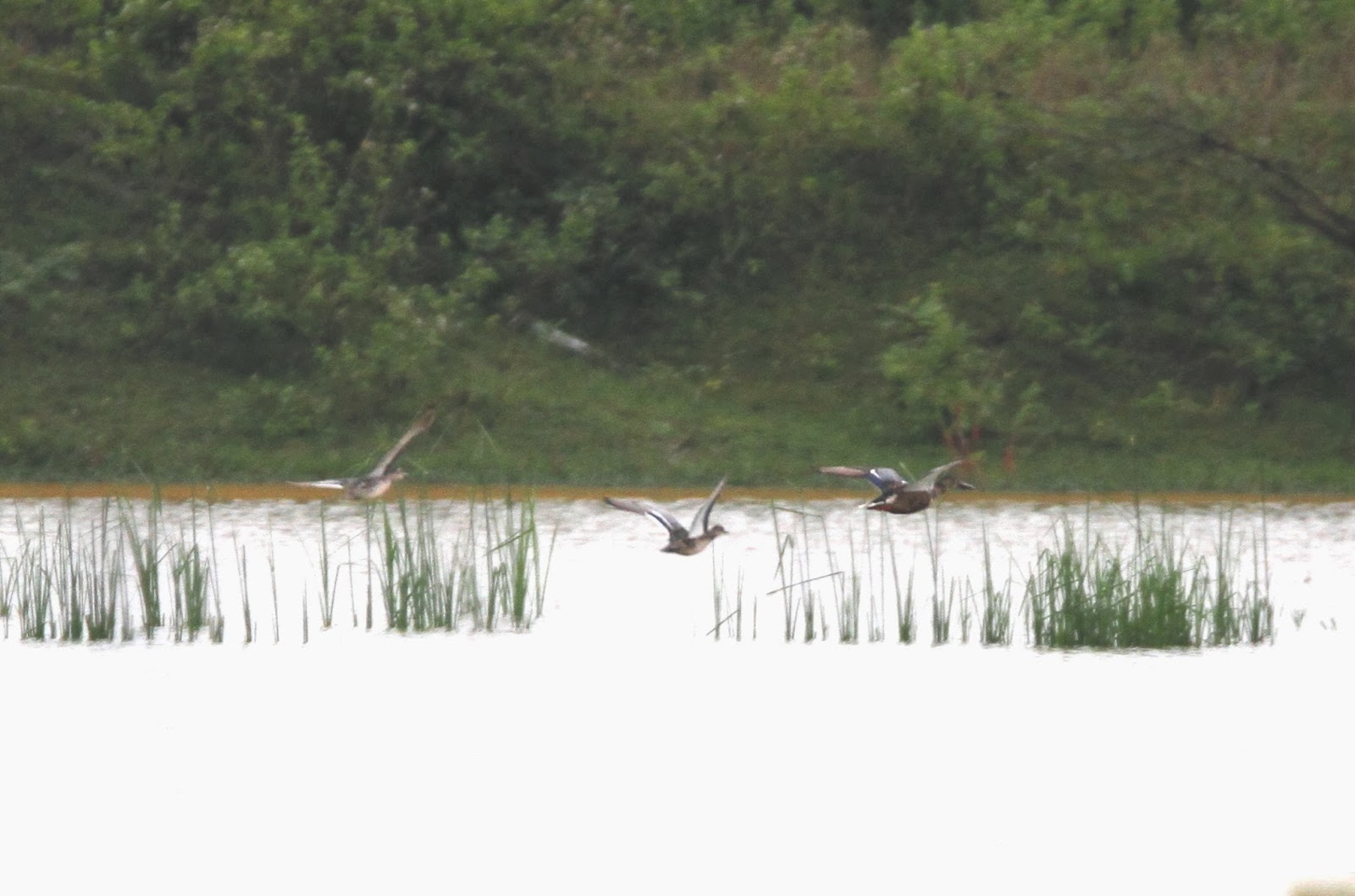
Here in flight leading a pair of Garganey after been spooked by fishing enthusiasts. They have to share the pond with human .......................
Thursday, 19 September 2013
DUCK 4/15 - Little Grebe
This is the common resident bird to see in freshwater ponds and marshland in peninsula Malaysia. They are quite shy birds and will often lurk within easy reach of cover along the margins of the water and will dive or disappear amongst the reeds when disturbed. they feed underwater and can dive and swim 30-50m to hunt for preys.
The usual clutch consists of between four and six eggs, laid in April in a floating nest of vegetation anchored to submerged water plants. Young grebes are frequently carried on the adult birds' backs and are fed with small fish, crustaceans and molluscs. Grebes often give feathers to their chicks, which the young birds swallow in order to form a protective lining to their stomachs. This avoids the possibility of the stomach being damaged by the bones of their fish meals.
Sunday, 3 February 2013
DUCK 3/15 - Cotton Pygmy Goose
Small individuals of this species are the smallest waterfowl on earth, at as little as 160 g (5.6 oz) and 26 cm (10 in). White predominates in this bird's plumage. Bill short, deep at base, and goose-like.
Male in breeding plumage is glossy blackish green crown, with white head, neck, and underparts; a prominent black collar and white wing-bar. Rounded head and short legs. In flight, the wings are green with a white band, making the male conspicuous even amongst the huge flying flocks of the Lesser Whistling Duck, which share the habitat. Female paler, without either black collar and only a narrow or nonexistent strip of white wing-bar. In non-breeding plumage (eclipse) male resembles female except for his white wing-bar. Flocks on water bodies (jheels), etc. The call is a peculiar clucking, uttered in flight.Its food is chiefly seeds and vegetable matter, especially water lilies; also insects, crustaceans, etc. In peninsula Malaysia; common sighting are in pond infested with water weeds in ponds stretching from Malim Nawar to Batu Gajah, Perak.
DUCK 2/15 - Lesser Whistling Duck
Lesser Whistling Duck
This is a largely resident species distributed widely across lowland wetlands of the Indian Subcontinent and Southeast Asia. They also occur on islands in the region including the Andamans, Nicobars and Maldives. To see them you have to go to Kinta Bird Santuary Bt Gajah.


.jpg)