Followers Do tag here to follow my latest posting

MikeBirder - Malaysian Birds

Hi

Welcome to my Malaysian Birding Blog. I migrated to blogspot.com as my blog at multiply.com closed shop in 2012. I wish to showcase all Malaysian birds that I have photographed whether here or overseas. My countdown of lifers started in 2005. Coming to March 2026 my countdown of lifers photograph has reached
595/688 species of birds of Malaysia in photos.

My shooting gear was a EF400mm f4 DO lens and Canon 7D body which to me is the ideal setup for mobility and bird chasing at that time. Eventhen the weight over my shoulder is more that 5.5 kg. As of June 2016 I have also acquired a Fuji XF 100-400mm OIS lens to complement my travelling cum birding trip overseas. My Fuji X-T2 went kaput recently and I upgraded to the X-T5 in 2023 ; the weight over my shoulder is much lighter now by 30%. In December 2018 I acquired the Nikon Coolpix P1000 as supplementary camera for distance shooting of 3000mm.
Fuji have finally made available their new XF 200-600mm lens which I yet to decide to spend another RM10,000. As for Fuji body I will stop with X-T5 36megapixel ..........

I am a weekend birder. Do feel free to drop me a line at mikebirding@gmail.com and I see whether you can tag along in my outings. My usual day trip is just an hour ride away to Hulu Langat, Lancang, Kemensah, Krau, Awana, Hulu Kali, Gombak Ole Road, Fraser's Hill , Bukit Tinggi and KSNP & Coastal Sg Janggut Jeram side of the coast . Overnite trip to Merapoh & Amp; Cameron, Air Hitam and further north to Kuala Sidim is a seldom affair but for lifer we travel. Panti in Johor is another good birding site that I yet to go. Then there are the Borneo birds of Sabah and Sarawak of Malaysia which I seriously much go to chalk up more lifers. This I did in 2018 to Sepilok Sandakan and Kinabalu Park. Next Danum and LahatDatu . In 2024 I visited a new happening birding spot in Talang Seremban.......

WARNING Birding is an addiction once you started its hard to stop. The wifey and children are now birding widow and orphan.

ALL PHOTOS IN THIS BLOG ARE COPYRIGHT OF MIKEBIRDER. KINDLY SEEK PERMISSION FROM THE OWNER IF YOU want to use them for commercial purposes.

Translate

Search for Malaysian Bird Photos

Showing posts with label broadbill. Show all posts

Monday, 24 September 2012

BROADBILL 1/7 - Silver-breasted Broadbill


 Silver-breasted Broadbill

All the silver breasted from Awana have migrated to Bkt Tinggi where they are striving in the dozen. Living amongst human at arm length. Best time to see them is during April - May when they start to nest and breed.

The Silver breasted is one of the smaller Broadbill at only 17cm slightly bigger than the Green. Notice the silver neckline which the name derive from. Next is to find the Dusky Broadbill which is the largest of them all..............


BROADBILL 2/7 - Long-tailed Broadbill


Long-tailed Broadbill

The Long-tailed Broadbill, Psarisomus dalhousiae, is a species of broadbill that is found in the Himalayas, Southeast Asia ie Malaysia. It is the only bird in the genus Psarisomus. The Long-tailed Broadbill is about 25 cm (10 inches) in length. It can be identified by its rasping squalling call of two syllable.

The Long-tailed Broadbill is a submontane (upto 2,000m) forest bird that lives on insects. It is very sociable and normally travels in large, noisy parties except during the mating season of March- May. It builds a pear-shaped nest in a tree. The female usually lays between 5 and 6 eggs that are incubated by both sexes; both sexes also help to feed the young.

Sightings in Frasers and Awana. Like other Broadbills they are show offs and there will be one daring fellow most often the male that will come close to you to pose and play. Wonderful bird..........now for the last ones Dusky and Banded my collection of Broadbills is complete.

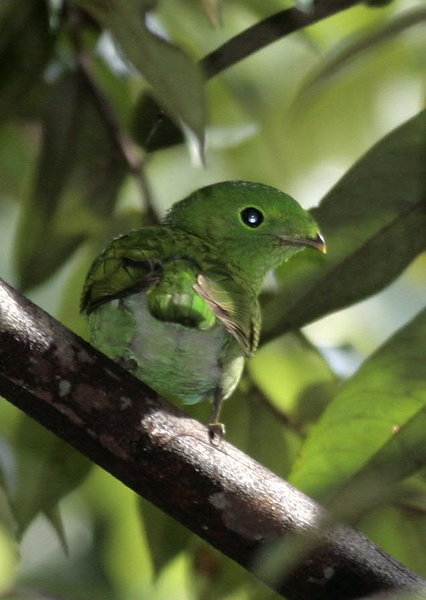
BROADBILL 3/7 - Green Broadbill

Greed Broadbill
 

One more broadbill for the collection. This is tiniest of the lot Broadbill that you can see in Malaysia. It size about 6 inches. It is best not to flash the bird as its feathers are quite luminous and irradiate thus blowing the details. Unfortunately it tends to keep to the darker areas of trees. If you are lucky you call call it out......

BROADBILL 4/7 - Dusky Broadbill


Dusky Broadbill can be found in lowland and submontane forest of Malaysia

They are the largest Broadbills upto 10.8 in (27.5 cm) in length. Most species have an exceptionally wide bill and gape. The dusky broadbill (Corydon sumatranus) beats all records among the passerines with a pink, hooked bill that is as wide as it is long. It even surpasses the skull in width. The more frugivorous Calyptomena and Pseudocalyptomena have a much narrower bill, but have retained a wide gape.

In terms of plumage coloration, the broadbills are a diverse group. Apart from a few dull-colored species, most broadbills are quite colorful, spanning the range from blue to red. Some species also have an area of bare skin around the eyes that is blue in the two Philippine Eurylaimus and pink in the dusky broadbill. Whereas the two sexes look alike in some species, more or less subtle difference can be found in others. Sexual dimorphism is most obvious in Calyptomena. Here the males are more intensely colored and the loral feathers form a forward facing tuft that covers the base of the bill, resembling a small crest.

This species is well known for its cooperative breeding behaviour. As many as 20 birds have been known to help in the building of the nest. Whether they also assist in incubation, brooding and other aspects of the breeding cycle have yet to be documented.

During breeding season if Mar-July a huge nest is suspended from the hooked end of a rattan’s frond. Made up of twigs, pieces of roots, dried leaves and masses of the epiphytic fern dragon’s tail (Pyrrosia piloselloides) unique to theirs only, the surface is embellished with spider’s silk and caterpillar excreta.The nest is suspended over an open forest clearing, pool or river, safe from most predators. The thorny suspensor discourages predators from moving in from above. The messy nest looks like a bunch of dried leaves and twigs that does not generally attraction attention.


BROADBILL 5/7 - Black & Yellow Broadbill

Black & Yellow Broadbill
 
Some closeup shots of the Black & Yellow broadbill. The features of male and female broadbill are alike. The color of the beak is so distinct. At most of the times they are shy and stay above but this time got to shoot it at close range of 15 ft away.

It came down to the ground level several occasion to hunt for grubs.

BROADBILL 6/7 - Black & Red Broadbill

Black & Red Broadbill
My sifu will be proud of me. Finally "break the egg" matter of speech. Many of you guys have already encounter it but for me its a lifer and hope the "egg will keep rolling" a figure of speech...... for more subspecies

Just luv their colours and the beak. B&R is commonest seen amongst the others like dusky; green; black & yellow , banded and silver breasted and the list go on. It is associated to water areas and come down to lower canopies but in shaded areas

Apparently the best time to see Broadbills is in April -May breeding and nesting period starts. In many parts of water areas and even under roads!. Looks like I have to wait another 10 months.............for the next.


BROADBILL 7/7 - Banded Broadbill

The Banded Broadbill was the best encounter among the subspecies that I have seen. In actual fact in South-East Asia SEA there are 11 species - of which 7 species can be found in Malaysia peninsula. We are lucky indeed, Malaysia can be hailed as a Broadbill country becos we could easily spot all the species that could be seen . Africa have the other 4 subspecies whilst Borneo - KK have the other 2 endemic Green Broadbills ie Hose's & Whitehead's Philippines has 2 endemic too

My previous encounter are as follows:-
1. Green Broadbill Near-threatened ( Uncommon Perdik UluLangat)
2. Black & Red Broadbill (Common FRIM and many lowland forest)
3. Long-tailed Broadbill (Common Bkt Tinggi/Awana)
4. Silver-breasted Broadbill (Common Ditto)
5. Banded Broadbill (Rarely - Kemensah)
6. Black & Yellow Broadbill (Common Kemensah)
7. Dusky Broadbill (Rare - Kemensah)

The Banded Broadbill has a very distinct rolling call. Come to think about it I would say that hearing the Banded Broadbill calls in lowland forest is quite often as its loud and sharp serenade can travel quite a distance over hill.

On the contrary, this bird is less seen when compared with the Black & Red or the Black & Yellow of the lowland Broadbills. The bird prefers middle storey, which means staying rather high on tall trees and silhuoetted in the canopy shade. This explain why the bird is spotted less frequent when compared to the other two Broadbills. While the nest may have the untidy Broadbill style outlook, these nests too are suspended very high up on the tree. Very much opposite that of Black & Yellow which is at low height and away from area with water.

As the name suggests, these are birds with very conspicuous bills. Short & broad. More important to note is the ostentatious colors that it has for its bill. As for the Banded is aquamarine blue lips. The bright colors simple punctuate the profile. Almost all of them, not gaudy, are very tastefully colorful. Most birders would agree with me that they are considered as one of the more beautiful birds. 4 of the species are generally small, just below that of an average sized bird. The long-tailed Broadbill with its tail looks very prominent as a fair size bird. The exception to this rule is the Dusky Broadbill. This bird is large, dark colored and comes with an "ugly" call as well and the largest beak second to none except the frogmouth's.