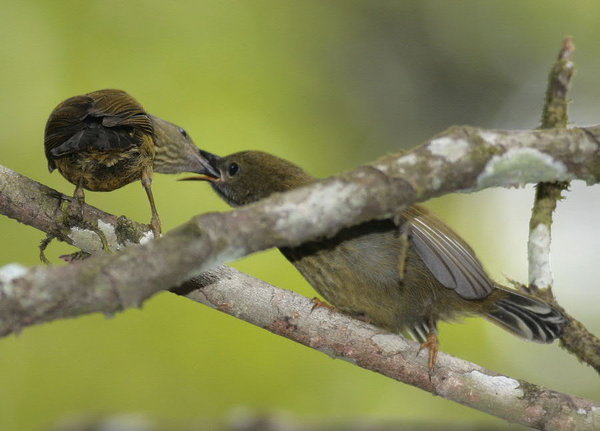
This is a much sort after sunbird in low land swampy forest like Panti KotaTinggi or at hill plains forest commonly Relau-Poring. It can be enticed to come out by calling of rowdy bird call. It is less common than the Crimson sunbird
Welcome to my Malaysian Birding Blog. My blog showcases my legacy of sightings of Malaysian bird in my lifetime - the countdown to 688 species and beyond. Actual numbers of birds you can see in Malaysia is more than 850 and adding.
Followers Do tag here to follow my latest posting
MikeBirder - Malaysian Birds
Hi
Welcome to my Malaysian Birding Blog. I migrated to blogspot.com as my blog at multiply.com closed shop in 2012. I wish to showcase all Malaysian birds that I have photographed whether here or overseas. My countdown of lifers started in 2005. Coming to March 2026 my countdown of lifers photograph has reached
My shooting gear was a EF400mm f4 DO lens and Canon 7D body which to me is the ideal setup for mobility and bird chasing at that time. Eventhen the weight over my shoulder is more that 5.5 kg. As of June 2016 I have also acquired a Fuji XF 100-400mm OIS lens to complement my travelling cum birding trip overseas. My Fuji X-T2 went kaput recently and I upgraded to the X-T5 in 2023 ; the weight over my shoulder is much lighter now by 30%. In December 2018 I acquired the Nikon Coolpix P1000 as supplementary camera for distance shooting of 3000mm.
Welcome to my Malaysian Birding Blog. I migrated to blogspot.com as my blog at multiply.com closed shop in 2012. I wish to showcase all Malaysian birds that I have photographed whether here or overseas. My countdown of lifers started in 2005. Coming to March 2026 my countdown of lifers photograph has reached
595/688 species of birds of Malaysia in photos.
My shooting gear was a EF400mm f4 DO lens and Canon 7D body which to me is the ideal setup for mobility and bird chasing at that time. Eventhen the weight over my shoulder is more that 5.5 kg. As of June 2016 I have also acquired a Fuji XF 100-400mm OIS lens to complement my travelling cum birding trip overseas. My Fuji X-T2 went kaput recently and I upgraded to the X-T5 in 2023 ; the weight over my shoulder is much lighter now by 30%. In December 2018 I acquired the Nikon Coolpix P1000 as supplementary camera for distance shooting of 3000mm.
Fuji have finally made available their new XF 200-600mm lens which I yet to decide to spend another RM10,000. As for Fuji body I will stop with X-T5 36megapixel ..........
I am a weekend birder. Do feel free to drop me a line at mikebirding@gmail.com and I see whether you can tag along in my outings. My usual day trip is just an hour ride away to Hulu Langat, Lancang, Kemensah, Krau, Awana, Hulu Kali, Gombak Ole Road, Fraser's Hill , Bukit Tinggi and KSNP & Coastal Sg Janggut Jeram side of the coast . Overnite trip to Merapoh & Amp; Cameron, Air Hitam and further north to Kuala Sidim is a seldom affair but for lifer we travel. Panti in Johor is another good birding site that I yet to go. Then there are the Borneo birds of Sabah and Sarawak of Malaysia which I seriously much go to chalk up more lifers. This I did in 2018 to Sepilok Sandakan and Kinabalu Park. Next Danum and LahatDatu . In 2024 I visited a new happening birding spot in Talang Seremban.......
WARNING Birding is an addiction once you started its hard to stop. The wifey and children are now birding widow and orphan.
I am a weekend birder. Do feel free to drop me a line at mikebirding@gmail.com and I see whether you can tag along in my outings. My usual day trip is just an hour ride away to Hulu Langat, Lancang, Kemensah, Krau, Awana, Hulu Kali, Gombak Ole Road, Fraser's Hill , Bukit Tinggi and KSNP & Coastal Sg Janggut Jeram side of the coast . Overnite trip to Merapoh & Amp; Cameron, Air Hitam and further north to Kuala Sidim is a seldom affair but for lifer we travel. Panti in Johor is another good birding site that I yet to go. Then there are the Borneo birds of Sabah and Sarawak of Malaysia which I seriously much go to chalk up more lifers. This I did in 2018 to Sepilok Sandakan and Kinabalu Park. Next Danum and LahatDatu . In 2024 I visited a new happening birding spot in Talang Seremban.......
WARNING Birding is an addiction once you started its hard to stop. The wifey and children are now birding widow and orphan.
ALL PHOTOS IN THIS BLOG ARE COPYRIGHT OF MIKEBIRDER. KINDLY SEEK PERMISSION FROM THE OWNER IF YOU want to use them for commercial purposes.
Translate
Search for Malaysian Bird Photos
Showing posts with label sunbird. Show all posts
Wednesday, 2 September 2026
Avian sighting July 2026 - Temminck's Sunbird
This is a much sort after sunbird in low land swampy forest like Panti KotaTinggi or at hill plains forest commonly Relau-Poring. It can be enticed to come out by calling of rowdy bird call. It is less common than the Crimson sunbird
Thursday, 9 March 2017
Avian Sighting- Purple-throated Sunbird
One of my elusive bird that I have yet to shoot in the wild is this Purple Throated Sunbird. The opportunity came at Cyberjaya in the month of March 2017
Labels:
sunbird
Location:
Cyberjaya, Selangor, Malaysia
Tuesday, 20 August 2013
SUNBIRD 11/11 - Ruby-cheeked Sunbird
Ruby- cheeked Sunbird
OK this is the last of the sunbird subspecies you can see in Malaysia. Forgot to post it. Got it few years back but never see it since. This is one of the most colorful sunbird that I have encountered. I was
taken by surprised when a group of 3 of them flew in. So many times I
encountered sunbird as close as 10-15 feet away. They somewhat do not feel
intimidated by human or r they curious with us guys with big camera lenses?
The male I saw have a full length dark band from its nostril to its nape. Its head and crown is usually is green but the one I shot was more toward turquiose The breast is distinctly orange while the belly is yellow. Sunbird are monogamous . Often if you see one, its partner can also be around. Sometimes a juvenile or two will tag along until itself finds a partner.
They are after nectar amongst the budding flowers or looking for grub I really not sure. Their beak are not as curvy as the others subspecies a whopping 170 of them in the world! They do feed on caterpillars and grub they find on branches and foliage.
The male I saw have a full length dark band from its nostril to its nape. Its head and crown is usually is green but the one I shot was more toward turquiose The breast is distinctly orange while the belly is yellow. Sunbird are monogamous . Often if you see one, its partner can also be around. Sometimes a juvenile or two will tag along until itself finds a partner.
They are after nectar amongst the budding flowers or looking for grub I really not sure. Their beak are not as curvy as the others subspecies a whopping 170 of them in the world! They do feed on caterpillars and grub they find on branches and foliage.
Sunday, 18 August 2013
SUNBIRD 10/11 - Copper-throated Sunbird
The Copper-throated Sunbird is found mainly in mangroves, but also coconut groves and coastal scrubland. I got mine in Pulau Indah Selangor after a tip off from JT. So the Ruby-cheeked Sunbird will be my last to shoot; I tot I have shot it before........hmmm.
Sunbirds eat insects but are best known for sipping on nectar. They have a typical long, slender, decurved bill with fine serration along the margins of both mandibles. Their tongue is tubular and deeply cleft.Although it is said that they cannot hover like a hummingbird (which is found only in tropical Americas), the sunbird can hover briefly. But they do prefer to cling to a nearby stem or vegetation as they sip on nectar. They may "steal" the nectar by piercing through the base of the flower (thus avoiding payment of pollinating services in exchange for the nectar).
It has this rapid twitter similar to Crimson Sunbird but lower; also a long very high-pitched trill. Will show it in video. It has this darting & sallying flight.
Like other Sunbirds, the Copper-throated male is more colourful than the female. In fact, females of most species of Sunbirds look very similar.It is large for a sunbird (14cm), bill thin and obviously decurved; appears all black in poor light. In good light, the male wears a green cap; copper throat and upper breast; dark purple lower breast and belly. Upperpart metallic green, tail blackish. In contrast the female looks like other sunbird females but has a greyish head. Upperparts dark olive; throat and under tail coverts greyish; breast and belly greenish yellow; tail black with bold white tips. Juvenile is like female but tail is brown. The Copper-throated male has two bright yellow tufts on his sides (See pic3), best seen when his wings are open.

Males are particularly territorial and may defend a good feeding site from other Sunbirds. This I notice when another male approaches the flowering shrubs nearby the one that I was shooting was very vocal and chase the other away.Sunbirds form monogamous pairs. The Copper-throated Sunbirds breed in April-August.
The female builds the nest, while the male escorts her as she finds and collects nesting materials. She uses fine twigs and leaves to construct a pear-shaped nest with an entrance hole at the top. The nest is usually built in a mangrove tree, 2-6 ft above the ground facing water (a pond or the sea). The eggs are pale brown with fine markings forming a band around the larger end. Both parents raise the young.Monday, 1 April 2013
SUNBIRD 7/11 - Olive-backed Sunbird
Olive-backed Sunbird
SUNBIRD 9/11 - Temminck's Sunbird
I was rather surprised to see it pop out from
nowhere at the open ground at the end of the Sg Perdik recreational park. I was
actually there looking for the Malayan Night Heron which was sighted early
December. I think it is still there as upon arriving in the early morning
something heron-like flew across the trail. A lot of Broadbill activities here today
in the wet and cool trail. As usual plenty of leeches.
The Temminck's Sunbird (Aethopyga temminckii) is fairly common and is found up to 1800 m altitude in Borneo, Sumatra, peninsula Malaysia, and south west Thailand in tropical or tropical moist lowland forests and subtropical or tropical moist montanes.
It is named after Dutch aristocrat and zoologist Coenraad Jacob Temminck,The male Temminck's Sunbird is 12.5 cm (male) long, . The longer-tailed male is mostly scarlet, except for a greyish belly, and yellow and purple bands between the back and tail. The female is drab olive, except for rufous fringes to the wing and tail feathers. I got the female in Bkt Tinggi, Pahang.
The Temminck's Sunbird (Aethopyga temminckii) is fairly common and is found up to 1800 m altitude in Borneo, Sumatra, peninsula Malaysia, and south west Thailand in tropical or tropical moist lowland forests and subtropical or tropical moist montanes.
It is named after Dutch aristocrat and zoologist Coenraad Jacob Temminck,The male Temminck's Sunbird is 12.5 cm (male) long, . The longer-tailed male is mostly scarlet, except for a greyish belly, and yellow and purple bands between the back and tail. The female is drab olive, except for rufous fringes to the wing and tail feathers. I got the female in Bkt Tinggi, Pahang.
With its curvy beak rufous wing and tail I
believe this is the Temminck's Sunbird. It can be found from lowland
broadleaved evergreen forest upto 1,500 odd metre high. It can also be sighted
in Cameron Highlands and in Belum Perak. Size wise it is 10cm long smaller than the male which has a longer tail. It favors nectar and insects and even spider. It is an uncommon bird to see in Peninsula Hopefully I will see the male soon in its splendor red. Well got to wait for the mating season in Feb-March.
Latest sighting Ipoh Kek Lock Tong
SUNBIRD 8/11 - Purple-throated Sunbird
Purple-throated Sunbird
Yet to see it in the lowland forest fringes,
mangroves and seaside undergrowth in Malaysia upto 1,200m. This photo shot in
Yogya bird market. In Peninsula Malaysia there is record sighting in Pedu Lake Kedah
A very small bird of 10cm. The male have this effervescent green crown with deep red belly and the rump is aqua bluish. The purple throat can be very darkish depending on the angle you look at it.
Nesting season is from Feb- July with a locket nest hanging with a side opening from height of 2m if you find one. Usually a pair of eggs is laid.
A very small bird of 10cm. The male have this effervescent green crown with deep red belly and the rump is aqua bluish. The purple throat can be very darkish depending on the angle you look at it.
Nesting season is from Feb- July with a locket nest hanging with a side opening from height of 2m if you find one. Usually a pair of eggs is laid.
In month of Feb 2017 got my first Purple Throated Sunbird in the wild in Lake Gardens in Cyberjaya. I will definately try to get better shots than the record shots here .................
Labels:
sunbird
Location:
Kuala Nerang, Kedah, Malaysia
SUNBIRD 6/11 - Purpled-naped Sunbird
Another surprise lifer in Taman Rekreasi
Ampang. The Purple-naped Sunbird was nursing its oversized junior in the month
of late June/July. Earlier thought it was the Yellow-vented Flowerpecker but
the blue purple naped and upper tail covert tells otherwise
Size less than 6 inches but the juvenile is larger and heavier looking. The latter was chirping away chasing calling for more food and the poor dad got to work doubly hard to please it. Mum is no where in sight Poor fellow!
SUNBIRD 5/11 - Brown-throated
SUNBIRD 3/11 - Red-throated Sunbird
Red-throated sunbird
The Red-throated Sunbird have a paler yellow breast and more maroon face and wing. It's size is also slightly smaller than the Brown-throated.
Friday, 15 March 2013
SUNBIRD 4/11 - Crimson Sunbird
Crimson Sunbird
I always wanted to get this bird and I was
lucky to sight it at Kek Lok Si Temple hill top road just below the KuanYin
statue venue. The better place to see it in the Penang botanical garden.
The Crimson Sunbird, Aethopyga siparaja is a small passerine bird (11cm) which feed mainly on nectar, although they will also take insects, especially when feeding young. Flight is fast and direct on their short wings. Most species can take nectar by hovering like a hummingbird, but usually perch to feed most of the time. They have medium-length thin down-curved bills and brush-tipped tubular tongues, both adaptations to their nectar feeding.
By the way Crimson Sunbird is the national bird of Singapore.
SUNBIRD 2/11 - Black-throated Sunbird
Its length is just a finger long 10-13cm. It can be differentiated from the
Purple throated from its abdomen color. The latter has crimson breast merging
into black. The female black throated is the plainer half.
Subscribe to:
Posts (Atom)