Followers Do tag here to follow my latest posting

MikeBirder - Malaysian Birds

Hi

Welcome to my Malaysian Birding Blog. I migrated to blogspot.com as my blog at multiply.com closed shop in 2012. I wish to showcase all Malaysian birds that I have photographed whether here or overseas. My countdown of lifers started in 2005. Coming to March 2026 my countdown of lifers photograph has reached
595/688 species of birds of Malaysia in photos.

My shooting gear was a EF400mm f4 DO lens and Canon 7D body which to me is the ideal setup for mobility and bird chasing at that time. Eventhen the weight over my shoulder is more that 5.5 kg. As of June 2016 I have also acquired a Fuji XF 100-400mm OIS lens to complement my travelling cum birding trip overseas. My Fuji X-T2 went kaput recently and I upgraded to the X-T5 in 2023 ; the weight over my shoulder is much lighter now by 30%. In December 2018 I acquired the Nikon Coolpix P1000 as supplementary camera for distance shooting of 3000mm.
Fuji have finally made available their new XF 200-600mm lens which I yet to decide to spend another RM10,000. As for Fuji body I will stop with X-T5 36megapixel ..........

I am a weekend birder. Do feel free to drop me a line at mikebirding@gmail.com and I see whether you can tag along in my outings. My usual day trip is just an hour ride away to Hulu Langat, Lancang, Kemensah, Krau, Awana, Hulu Kali, Gombak Ole Road, Fraser's Hill , Bukit Tinggi and KSNP & Coastal Sg Janggut Jeram side of the coast . Overnite trip to Merapoh & Amp; Cameron, Air Hitam and further north to Kuala Sidim is a seldom affair but for lifer we travel. Panti in Johor is another good birding site that I yet to go. Then there are the Borneo birds of Sabah and Sarawak of Malaysia which I seriously much go to chalk up more lifers. This I did in 2018 to Sepilok Sandakan and Kinabalu Park. Next Danum and LahatDatu . In 2024 I visited a new happening birding spot in Talang Seremban.......

WARNING Birding is an addiction once you started its hard to stop. The wifey and children are now birding widow and orphan.

ALL PHOTOS IN THIS BLOG ARE COPYRIGHT OF MIKEBIRDER. KINDLY SEEK PERMISSION FROM THE OWNER IF YOU want to use them for commercial purposes.

Translate

Search for Malaysian Bird Photos

Showing posts with label wren babbler. Show all posts

Sunday, 5 July 2020

Avian Sighting July 2020 - Pygmy Wren Babbler


These are my best photos thus far of the Pygmy Wren-Babbler. I managed a speed of 1:125 or 250 at high ISO of 1600. Lighting was just perfect ie  bright overcast lighting at about 1.30 pm for me to get these pictures. As the bird is quite hyper during its venture out to the feeding log;  you really need higher speed to freeze the action. Most of the time you are about to get focus on it and trigger your shot and the bird is no longer in the frame WTFlower...........

There is no juvenile sighted other than the Grey-throated Babbler. The other common one namely the Buff-breasted Babbler  is still around. 


Tuesday, 16 July 2019

Avian Sighting July 2019 - Streaked Wrenbabbler

I am so happy to reacquaint with a Streaked Wren in Bukit Fraser. I have not seen the bird for the past 2 years. It used to be a common sighting at Ulu Kali. It is one cute &  beautiful bird with its "angry bird" look. Wrenbabblers are very loud melodious birds and it is  no exception.

Okay guys it is at the Hermant's trail port so do drop by in the morning to shot it.


Wednesday, 20 March 2019

Wren Babbler 6/7 - Striped Wren Babbler (lifer 522)


The Striped Wren-Babbler can be seen in lowland dense forest in Johore side namely Panti, EndauRompin Pahang side to name a few. Sighting is also recorded in Taman Negara as well in Danum Sabah. Like all other Wren Babbler, it is a crooner and can response and duet with your callback for minutes at time. Its call is a melodious long "chuii" mono call. Video to be provided later.

They have a large radius feeding area and they drop by only once at a locale if you are near its feeding route.  If bird luck is not with you then  it not your time to see this bird.

The SWB is a medium size Wren Babbler coming in at 15cm compared to Eyebrowed or Pygmy below 10cm of the hill-lands. The adult showed here have a black mantle crown-nape with white specks buff lore. Its brown wings and breast side also got white streaks.


The last Wren Babbler that I need to look out for is the Eye-browed Wren Babbler  which we have record sighting in the hills of Negeri Sembilan and Bukit Frasers.


Thursday, 1 November 2018

Wren Babbler 5/6 - Bornean Mountain Wren Babbler (lifer 507 - Bornean 14/100)


This is another endemic bird  that you can see in KNP.  Mountain Wren-babbler from a distance looks similarly to our peninsula Streaked Wren Babbler in looks and antics.


It is another crooner and will fly in out and over you as it duet loudly with our playback. 


It is about 14 cm in size. Pale-streaked dark chunky small babbler with dull white throat and dull rufous belly, bristly forecrown feathers projecting forwards.Its crown to lower back has  blackish streaky feathers and the white faint supercilium /brow.


Sunday, 19 May 2013

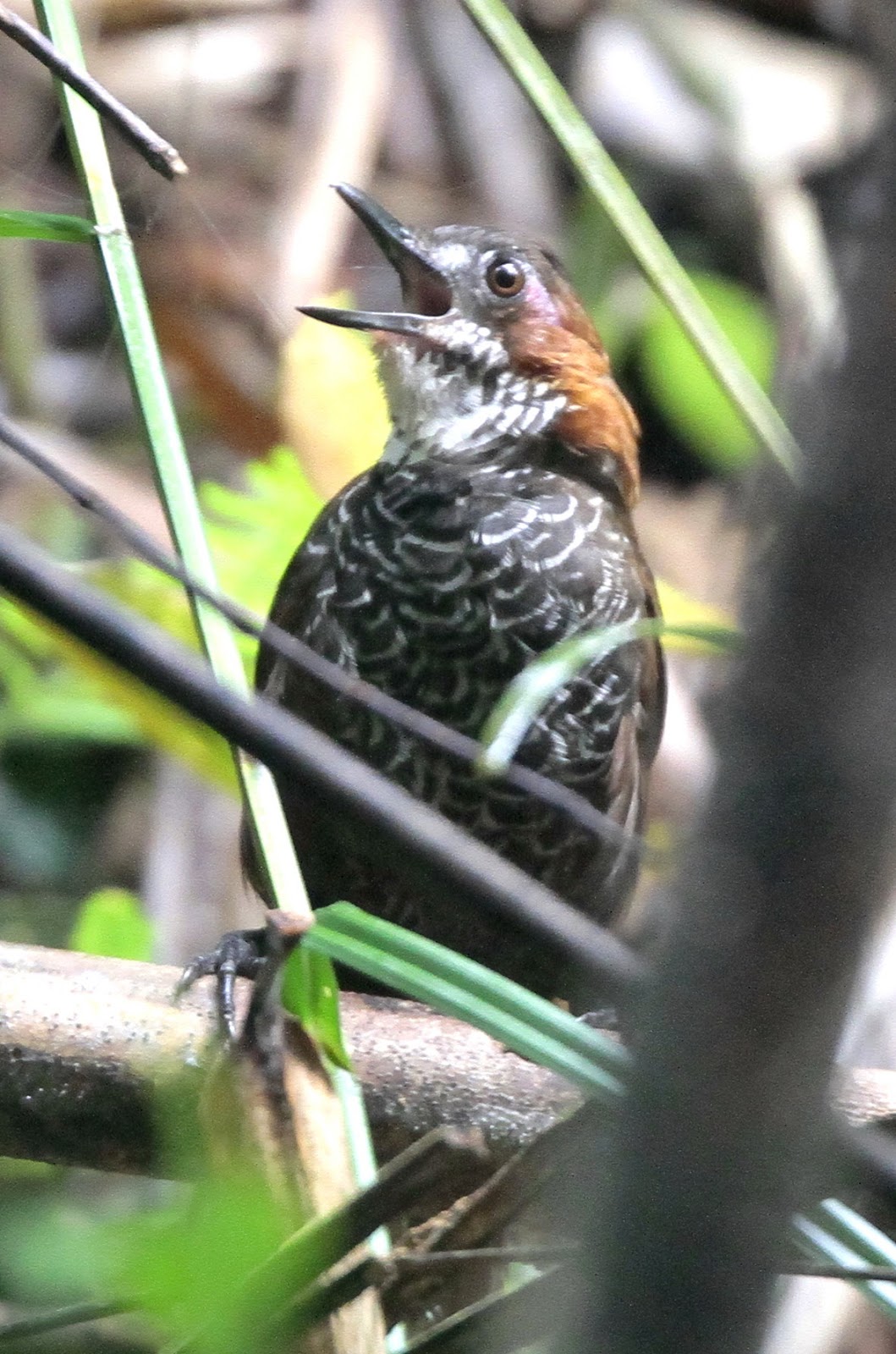
WREN BABBLER 4/5 - Marbled Wren Babbler

 Marbled Wren Babbler
I am no longer envious of Davey as I finally in his league to shoot this elusive bird in Fraser hill. Like any other Wren Babbler,  MWB are beautiful crooner and can duet for long period of time. In the months of March-June they tends to be most approachable and can be enticed to show itself but not entirely; as you can see in my pictures.

Why it is called marbled wren is because  of the uniform white fringed black scaly feather on its entire chest and belly. It is even larger than its lowland cousin Large Wren Babbler  (8 in/20cm) by a good cm. It has a longer tail I suppose. Come to think of them they do have some similarities........

The Marbled Wren-babbler  is a species of bird in the Pellorneidae family. It is a resident of Indonesia and Malaysia. Its natural habitats are subtropical or tropical moist lowland forests and subtropical or tropical moist montane forests. In Peninsula it is more on hill forest  upto an altitude of 1,000m or so.


Wednesday, 15 May 2013

WREN BABBLER 3/5 - Large Wren Babbler

Large Wren Babbler


Surprise surprise a rare sight for the month May.

Normal size Wren Babbler is about 4-6 inches. This one is about 8 inches Not really large........mmmph. Distinguish blue eyering with black and white lore. Have a clear & beautiful voice call and yet very elusive and shy bird.

Found in broadleaved forest . Like many babblers it keep itself in dark corners of understorey bushes. It can mimic call of various other birds just like the Lyre bird.


WREN BABBLER 1/5 - Streaked Wren Babbler


 Streaked Wren Babbler

It was another outing with Jason This time to Awana for the morning. That morning was misty........ very misty than usual. We were there to catch the Blue Hill Flycatcher.

With the familiar chirping of "chiuee" or "chuuii or something like that of the tailorbird. Apparently the chirping is important to id a babbler. So many of them. Jason point me to the movements in the undergrowth. The ST Babbler is a resident in Malaysia hills upto 750m but the hot weather may push them higher. For me its a lifer but Jason he have encounter them before...... tell me to be patient and stay still and it will come down onto the road. And indeed it flew down a pair of them maybe a family of 2 with their offsprings. 6 inches in length. Adult the crown is darker black and red eyed.

It is nice to know they are flourishing and their habitat still there. Sad to see people are dumping building debris and furniture down the ravine at the track


WREN BABBLER 2/5 - Pygmy Wren Babbler

 Pygmy Wren Babbler

The smallest of the Wren Babbler at 8.5 cm in size made worse with no tail. A very rounded bird keeps to the mossy wet slope and ravine wall of trails and road of Awana, Frasers and Cameron birding grounds. Most of the time you hear it with 2 high low syllable call "wheeuit chuuuit" sulking in the undergrowth. Hops about in search of grubs rather than fly. I observed they do move about on a common trail...... so the idea is to wait patiently along any clear route. Best time is about 7-9 am.

There are two morphs the dark and the pale morph. The one pictured is the latter with the whitish scaly-liked chested whilst the dark morph have a more tanned scaly breast.