Followers Do tag here to follow my latest posting

MikeBirder - Malaysian Birds

Hi

Welcome to my Malaysian Birding Blog. I migrated to blogspot.com as my blog at multiply.com closed shop in 2012. I wish to showcase all Malaysian birds that I have photographed whether here or overseas. My countdown of lifers started in 2005. Coming to March 2026 my countdown of lifers photograph has reached
590/688 species of birds of Malaysia in photos.

My shooting gear was a EF400mm f4 DO lens and Canon 7D body which to me is the ideal setup for mobility and bird chasing at that time. Eventhen the weight over my shoulder is more that 5.5 kg. As of June 2016 I have also acquired a Fuji XF 100-400mm OIS lens to complement my travelling cum birding trip overseas. My Fuji X-T2 went kaput recently and I upgraded to the X-T5 in 2023 ; the weight over my shoulder is much lighter now by 30%. In December 2018 I acquired the Nikon Coolpix P1000 as supplementary camera for distance shooting of 3000mm.
Fuji have finally made available their new XF 200-600mm lens which I yet to decide to spend another RM10,000. As for Fuji body I will stop with X-T5 36megapixel ..........

I am a weekend birder. Do feel free to drop me a line at mikebirding@gmail.com and I see whether you can tag along in my outings. My usual day trip is just an hour ride away to Hulu Langat, Lancang, Kemensah, Krau, Awana, Hulu Kali, Gombak Ole Road, Fraser's Hill , Bukit Tinggi and KSNP & Coastal Sg Janggut Jeram side of the coast . Overnite trip to Merapoh & Amp; Cameron, Air Hitam and further north to Kuala Sidim is a seldom affair but for lifer we travel. Panti in Johor is another good birding site that I yet to go. Then there are the Borneo birds of Sabah and Sarawak of Malaysia which I seriously much go to chalk up more lifers. This I did in 2018 to Sepilok Sandakan and Kinabalu Park. Next Danum and LahatDatu . In 2024 I visited a new happening birding spot inTalang Seremban.......

WARNING Birding is an addiction once you started its hard to stop. The wifey and children are now birding widow and orphan.

ALL PHOTOS IN THIS BLOG ARE COPYRIGHT OF MIKEBIRDER. KINDLY SEEK PERMISSION FROM THE OWNER IF YOU want to use them for commercial purposes.

Translate

Search for Malaysian Bird Photos

Sunday, 12 July 2015

AVIAN NESTING 10/100 - Black-naped Monarch


The Black-naped Monarch has the most obvious and easily seen nest you can encounter during breeding season in the lowland forest like Bukit Rengit,  Merapoh or Sg Perdik  to name a few localities. Both the birds take the effort to build the nest  usually along trails and road track and at 6-9 feet from the road level.  In late May we saw 2 nests been  made by possibly the same pair at about 20 ft apart from each other  . Eventually this one was selected.


Thursday, 9 July 2015

AVIAN NESTING 9/100 - Bronze Drongo


Two Bronze Drongo nest was seen in May 2015 at Taman Negara. Both of them about 25-30 ft high on  an exposed tree. Breeding season can starts as early as February until July. The nest is usually  at the tail end of a  horizontal twin branch. Usually the hatching is done by the female whilst the male will be closeby to protect the nest against intruders.

They are aggressive and fearless birds which they will attack any size birds which threatened
their nest. Some birds like flycatcher and smaller bird would built their nest nearby Drongo nesting to take advantage of their aggressive behaviour.

At one time we actually witnesse one of the Drongo reacted aggressively against a bulbul which wandered too close the nest and it was attacked by the Drongo. The bulbul lost a few feathers for its venture. A feather floated down onto my hand.


Sunday, 5 July 2015

AVIAN NESTING 8/100 - Collared Kingfisher


Kingfisher tends to make their nest hole in earth stump or riverine embankment. In the case of the Collared their nest is a hole, either a natural tree hole or a burrow excavated by the birds themselves in a rotten tree, termite mound rather than in earth banks. They will also occupy old woodpecker holes. Both parents take part in incubating the eggs and feeding the chicks. The young birds leave the nest as long as 30 days after hatching. Two broods are often raised in a year. At Kuala Selangor  we saw the Collared Kingfisher improvise  and dug a hole in the softer side of the root ball of dead palm tree trunk which was lying  on the trail.  The exposed nest was easy shooting  for us. I make do with umbrella and poncho covering and remain still to observe their feeding habit.


You can expect at least 2-3 chicks per nesting. There are record of 5 though. Both the parent are responsible to bring food to the nest. Small crabs are the favoured food in coastal regions but a wide variety of other animals are eaten including insects, worms, snails, shrimps, frogs, lizards, small fish. The bird perches almost motionless for long periods waiting for prey. When it spots something it glides down to catch it and then flies back to the perch where larger items are pounded against the branch to subdue them before delivering to the nest.


Wednesday, 1 July 2015

AVIAN NESTING 6/10 - Coppersmith Barbet


Coppersmith's nest can be left over hole of woodpeckers. Here we saw a pair  trying out the hole in a dead tree trunk. We will not be sure whether they will adopt it or not or wait for some other better hole which was currently occupied..........

The hot dry season has already begun on set of July 2015 in Jeram.

Monday, 29 June 2015

AVIAN FIELD REPORT 11/100 June 2015 - A Visit to Jeram Kuala Selangor


In the month of June 2015, I went exploring  coastal plains in Selangor. The site near  Jeram is near perfect and  secluded. It getting a bit dry coming to the end of July. The habitat have conducive muddy  coastline for shorebirds, linear mangrove patch, palm oil plantation and open shrubland in between. A pair of Black-shouldered Kite resident to the locale for the few times I was there.

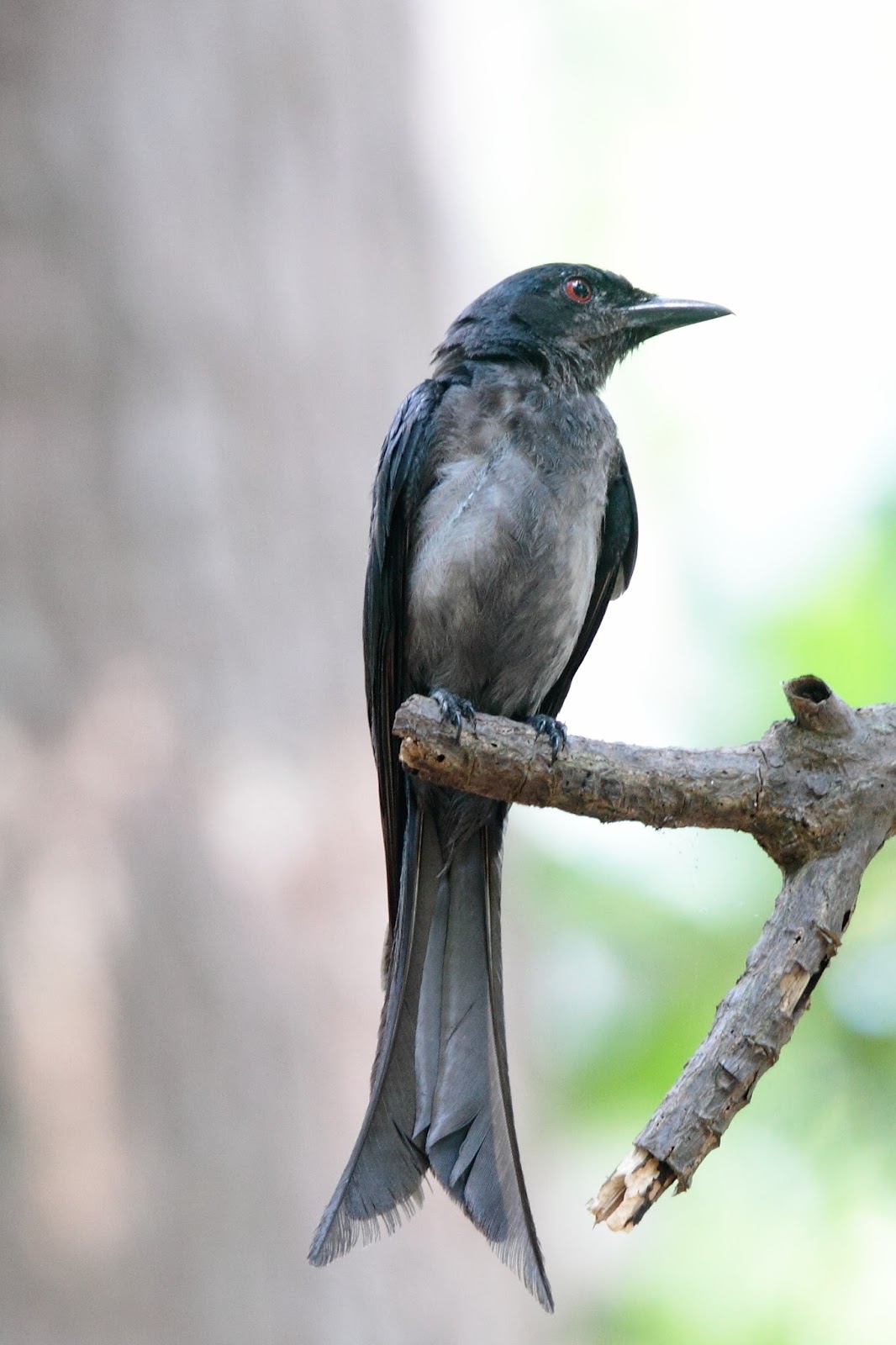
Within the matured mangrove patch you can see Great Tit and Ashy Drongo.  There is no Mangrove Pitta here though. The Sunda Pygmy Woodie is a sure see at Jeram. There were no response from the otherwise Mangrove Whistler.


The Blue-throated Bee eater are having a feast here. We counted less that a dozen. They are  the first of the 3 species of Bee eater to arrive from the Northern Hemisphere. A foursome Lesser Adjutants flew over our heads to roost during the hightide at about 11.30am. Never been good at flying shots.....


The Shrubland  have plenty of action. A pair of Red Whiskered was sighted but very shy and flew away when ever I tried walking closer.


Arriving at the site a male Koel was the first bird I saw perched on a dead tree trunk over the marshland at Jeram. As usual it was very vocal. The female was not seen thought. A  rather yellow immature Black-naped Oriole drop by after that.


Walking into the palm oil plantation to explore a fruiting ficus I flushed a pair a Large Nightjars. One of them perch on branch looking at me. Luckily the beauty stayed there ready to take flight if I move nearer. After my photo shoot  I left it where it is.


Coppersmith Barbet is quite comment at this coastal enclave. A pair of confiding White collared Kingfisher was seen watching me from a distance of 25 ft. The male was seen with some prey in mouth supposedly to offer to its partner but later gulp it.

 
A pair of Pied Fantail  where hunting amongst the low shrubs. One was chewing up a red dragonfly whilst its partner looks on closeby. It took itself about a few minutes before it managed to gulp the entire prey.


The shore line and river mouth still have handful of familiar waders that stayed behind for the summer. Life is too good in Peninsula Malaysia

Friday, 26 June 2015

WADER 51/60 - Eastern Curlew


The adult  Eastern is much larger than the Eurasian by a good 6cm and has a longer curly beak. It breast and head is much buff and it has an  overall  browner coat. This shot was about 500-600m away at the low tide shoreline. I was testing out the Nikon P900 with its 2000mm reach. I was shooting at maximum zoom on a cloudy day. As you can see the sharpness and details  is wash-out but for identity purpose its okay. You really need a lot of patient and effort from located a bird in the viewfinder and  focussing .  My eyes was teary and sore using the low resolution viewfinder. Unlike the Olympus new Superzoom SP100 (50x)which has a pop up  dot scope sight  to locate  bird  when using LCD screen you face a big problem to find the bird from the EVF or Screen if you use the P900 at its maximum zoom. What I have to do is zoom out and then zoom in again. Focussing in the heat haze is another problem. 
Tawau sighting April 2023

Monday, 22 June 2015

AVIAN NESTING 5/100 - White Morph Asian Paradise Flycatcher


It was late May 2015  we were tipped off by a good birding friend. Seeing this beautiful white morph APFc sitting in its tiny little mossy nest was avian bliss. Stumbled upon it  off the trail about 800m from the bridge.  If it was the female it would be more discreet for me to notice. The nest was about 10-12 ft from the ground in a valley. So we were shooting slightly above the nest off the trail which was perfect.

So nest building may have started in early May. It appears that the location & selection for the nest is decided by the female ideally on a twin or 3 branches stump of a singular 20 mm diameter stem young tree of about 10-15 ft. The spot must be in a clearance away from  other trees and undergrowths as well as off  any trail or track. This may be to prevent predators from jumping onto their nest.  If you find drongo nesting nearby; there  is a good chance  a APFc nesting can be possibly nearby. In our case there was one about 150 meters away. It is a synergy taken to take advantage of  the drongo aggressiveness to keep predators away. 

The Asian Paradise Flycatcher is monogamous and  it is the female who do the choosing its partner. Those female who matured earlier will have the first choice of choosing the more matured male, the white morph. Those with no choice will  have to be contended with the short tail rufous Paradise Flycatcher. This assumption came about from observations from other read.

Whether the  male bird handles the nest building task by himself it is for the ornithologist to study. Not sure about this as other reports mentioned that the nest building is  done by both the adults. Multiple eggs are commonly laid in a neat cup-shaped nest, usually lined with root twine and decorated with living mosses and liverworts as camouflage.


The first hatchling was sighted on 7 June 2015 and the feeding starts immediately. Most of the initial feeding is tiny insects like flying beetle and  spider. The parents will call out and the alpha chick will response and open its mouth naturally.


My fellow birder MowSum is monitoring the progress and  3 chicks have hatched and they are growing healthly. Here are 2 photos credited to him. After 10-14 days from the day of hatching the threesome should have fledged................