I got myself a replacement to my broken Nikon P900 in the like of the new Nikon Coolpix P1000 in December 2018. It cost me RM4000 with an extra battery and free Sandisk 16Gb SD Card. Currently a new P900 have dropped to about RM2,000 and it is still available. It was dissapointing however that the P900 battery is not compatible for those people wanting to upgrade. There is still no external charger provided in the box and you have to charged thru your camera unless you buy it separately which was not available still from YL Camera.
I need this camera for the sole purpose of shooting wader and open range bird photography beyond my 600mm (400mm x 1.5 cropped sensor factor) reach. It was never meant for fast and active bird photography nor birding in low light condition ie under canopy birding of Malaysia jungle. Why ........ AF will be a frustrating affair.
The features and improvement the P1000 over its predeccessor that I like to comment are listed as follows:-
- I can now mount my Olympus spotting scope on the flash horseshoe which the P900 has none. Nikon also have come out with their own branded spotting scope which you can buy separately. See Picture one. This is useful when you use the LCD screen for your photography to which you can pin point the bird thru the spotting scope and then focus from the screen and not the EVF. I prefer the latter to save power consumption. It supposedly for BIF shooting using the spotting scope on Continuous Focus.
- The Telezoom hava a better reach from 2000 to 3000mm but the weight and size of the camera has balloon to 1.4kg or 3 lbs. It will be more tiring on the neck and arms. It is best it is mounted on a monopod for long birding hike. Say goodbye to Digiscoping.
- The VR at 5 stops is still there for handheld birding or shooting at speed of 1/60s
- The P1000 still maintained a Bird mode which is more for autofocus videography...... not my interest but I think its useful and some more upgraded 4K video quality. I thought it would be able the recognised the silhueotte of a bird. Actually in Bird mode the camera is optimised for IQ in term of ISO limit to 800 and TV speed priority with the Aperture at constant. I notice it automatically increase Exposure Compensation or issit me !!!
- The new feature is a 500mm prezoom button which is somewhat useful when you lost sight of moving bird at say 2000-3000mm zoom. When pressed the lens zoom out back to 500mm range for you to locate your bird. Only when you release the button it will quickly snapback to its original zoom. Picture below the left button next to the T-W up-down zoom switch.
6. Exposure compensation (5 stops) can be set without leaving the EVF for those birds in low light or bright background.
7. Shooting buffering is still an issue for long burst shooting but a vast improvement. Forget about raw file shooting as the waiting writing get worse.
8. The battery supposedly rated at 250 shots is rather pathetic (but I been shooting more per battery LCD turn off). Anyway you better get an extra battery for a full day birding session. I am sure you can attach a powerbank thru its microusb port to extend your shooting outing.
Photo Sampling
My P1000 review is based on layman's point of view. I also will compares its output to my Fuji XT2 from a distance of 50 ft out to 60 ft. Anything beyond the P1000 is expected to fair better. I usually shoot in Jpeg and AF mode rather than RAW and manual mode.
Scenario 1 - Shooting comparison from below 30-50 ft
As a start I was shooting from same position of 50-60 ft of a Black Drongo in my car using beanbag for support. I then cropped to suit without much processing. Condition of shooting in open harsh lighting.
- The Bokeh of both camera are identically soft and creamy.
- The Saturation and Contrast IQ of the Fuji setup is much better. The P1000 have more flare and burned out areas like the beak and branch.
- In the close distance P1000 can be zoomed in to full frame and thought to gain more details. But I do not know whether it was me the P1000 picture is a bit wash out and soft as compared to the Fuji XT-2. Its depth of field is also questionable poorer.
- My only conclusion is the smaller sensor 16mp on a 1:2.3 inche sensor ( 28.45mm2)which is very small comparitively to the full APSC 1 inche sensor (368mm2) of the Sony or Fuji that is doing injustice to the picture. It is slightly bigger than current smartphone sensor!!!
From what I see bird photography at distance below 50 ft. I would prefer my XT-2 than the compact zoom camera in term of better IQ and sharper telephoto lenses. More importantly the AF focussing is more precise and way faster.
 |
| This is a full frame shot at 1200mm zoom from P1000 (6mp file) |
 |
| Fuji XT2 cropped to 1.13mp file from max 600mm (24mp 1.5 cropped inche sensor) telezoom which is equivalent 1500mm of the 16mp 1/2.5 inche smaller sensor of the Coolpix P1000. |
 |
| Nikon P1000 50% crop to 1.6mp file from 6mp zoom 600mm |
Simulation B Shooting in 90-120 feet away
For such a distance any Dslr below 600mm like my Fuji 100-400mm x 1.5 crop factor will not able to get the IQ full frame zoom in at say 2000mm. Depending on the day haze or morning dew the IQ can get worse.
 |
| Shooting at 400mm Actual output It is over-exposured as I notice later the camera was in +1.5EC whether accidentally or the camera set it on its own...... |
 |
| Shooting at 1000mm |
 |
| Shooting at 2000mm |
 |
| Shooting at 2000mm Cropped in original colors and IQ with EV+1.5 |
 |
| Cropped and enhanced in Canon EX Browser |
As you notice the camera is most useful in good lighting condition and for static birds on a perch or in the open ground. It sharpest zone is below 2000mm. ASA should not be set beyond ISO800 as resolution and noise becomes very apparent.
Scenario B Shooting at distance of 180-200 ft
I was fortunate to chance on a Black-shouldered Kite perched in the middle of the padi field. I manoeurved my car to a position that the background is at dark densed vegetation. The focussing is made easier for the static shoot-out with its high contrast eyes. However the windy condition may have affected the sharpness. I was able to get 1out of 2/3 of sharp images in the condition.
 |
| Actual Framing at 2000mm from a distance of 200 ft AV Speed 1:500 |
 |
| Cropped Picture 50% of above |
 |
| Blacked-shouldered Kite actual framing. It is common the white colors of the subject is all burned out. Even when using matrix metering. For this camera it is recommended not to use spot metering. The dynamic range is poor period. This is because of its smallest of all sensor. |
 |
Cropped 50% from picture above. Need to compensate EV -1.3 so that to get better IQ though it is still soft.
Fortunately it was shoot with a dark background. If it was in front of a bright background the Sharpness will be affected.
This last shoot is at full frame no cropped at 3000mm zoom. As you can see the white feathers are all wash-out without any resolution. The eyes are in sharp focus though. The exposure metering is not doing a good job here. It was set in Spot metering.
Scenario C Shooting in Bird mode
In Bird mode the camera cannot get AF focussing if there are foreground foliage the bird which I presume what Bird mode should do. You have to turn to manual focussing mode which the P1000 have a dedicated flick-button . I did not tried the video recording whether it works. Instead the Bird mode actually only optimise the IQ with the downplay of ISO below 600 and Shutter Speed to avoid blur which I still encounter plenty in the ratio 5:1 bad shots. In the case I may as well shoot in TV Speed priority which fair better.
 |
Shooting from car at a distance of 80-100 ft
|
|
|
Moving the car to a more open view and walla full frame shot at 1500mm. Shooting Distance is about 90 ft
|
The shallow depth of field also a concern at zoomed to full frame shots at all range. I would rather shoot at zoom range that frame the bird half the frame size and then cropped it to suit.
Scenario D - Shooting Active bird and low light condition
I went to Awana Genting to try shooting active birds. In bird mode which any novice will shoot in, I notice the camera decide to set TV at 1/40-1/60, ISO 400 and at times EV compensated to plus side. It will come up muddy and wash out. However once you post edit the photo you can still get back the IQ. However certain area like the rufous head is still wash out and flat.
The above photo of LaughingThrush is the actual output at TV1/4s frame 500mm focal range and below after post edited and cropped.
Another photo ; this time in full frame 800mm focal range. Again over-exposed and then post edited to suit. The whites are all wash out still .............
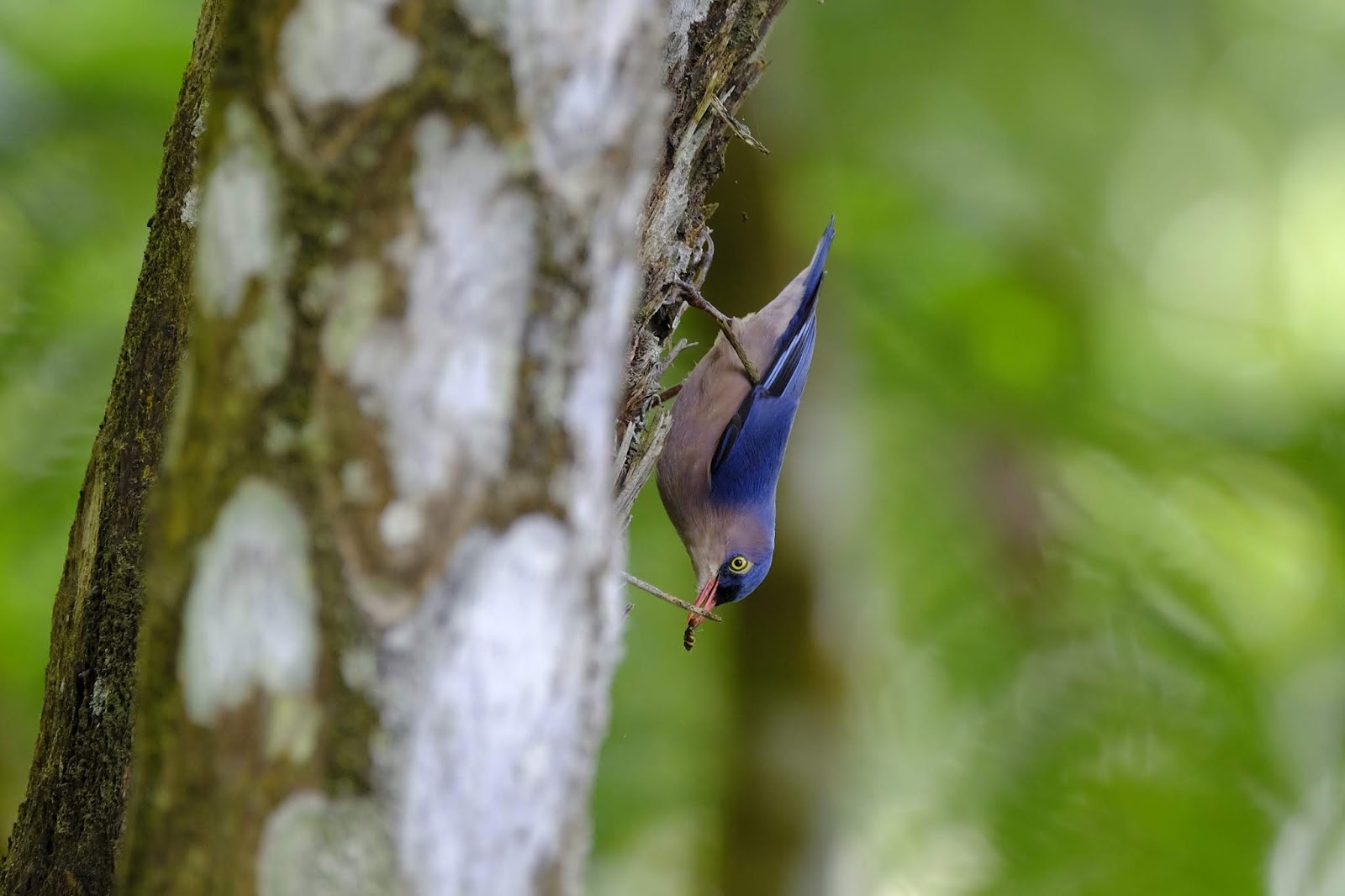
At Awana I got the opportunity to shoot a pair of Velvet-fronted Nuthatches in a bird wave for a good 10 minutes. However opportunity for momentarily pause of this bird was my only chance of a focussed picture. This was one my only 1-2 shots in focussed from the lot LOL.
Above picture was cropped and post-processed from the original framed picture below. Shooting at 600-800mm at low TV1.60s. It is not recommended to shoot full framed of such active bird as locating it in your EVF then is near to impossible.
Below is another series of photos shot in low like condition in Bukit Rengit at TV1/15s upto to 1/30s. I did shoot the many other species like the Short-tailed and Babblers like Ferrugious Babbler Most if not all of the latter photos came out blurred by movement or noisy soft images due to low lighting Again I was left frustrated with the AF focus. Bird mode was totally unuseable here for the start of trying to get them in focus as the camera AF keep on hunting.
800mm Focal Distance from 40 ft
1000mm Focal Distance. Focussing was much easier for contrasty bird like this
If you blow up to 1:1 the feather features are not as good as my XT-2 capture (50% cropped still) shown below
Fuji XT-2 cropped 50% has better IQ & resolution compared to my P1000 non cropped picture
My Conclusion and Recommendation
P1000 is a useful and practical camera for shooting birds in the open and reach beyond 150-300ft (50-100m). Any further the haze and dusty condition will deteriorate the image quality and sharpness. Practical for birding is its 500mm prezoom/snapback button to relocate a bird out of frame and the exposure compensate button is useful but limit to +-2 stops. The spotting scope is now attachable unlike the P900 which have no flash mount.
- Bird Mode is just a fad and I think really do no help much to my captures. The automatic EC is a nuisance or is it the accidental touch of my palm on the back when I was shooting. Nevertheless it is an issue. Many of my pictures comes out wash-out because of it.
- I still find the focussing is still a problem as the P900 especially low contrast birds and against bright background. Picture capture are soft most of the time in multiple shooting when hand held. I would say 1 out of 5 of my shots are only useable and that said it only worth for ID only. Nikon need to improved on this.
- Exposure Metering is still not perfect as your shots can easily burn on whitish feathers. Best to put on Matrix metering than Spot metering. Nikon need to improve on this.
- There is no way to move the focussing point in the EVF view unlike the Fuji XT-2 which is very useful to pinpoint metering and focussing in framng the bird especially full frame shot. Nikon pls note.
- Focussing tends to hunt alot if the lighting condition is not good. For example against bright background and pale contrasting bird against the foliages. It would rather focus on the leaves instead of the bird ....WTFlower! See below.
- Ideally the best shooting range is at its 2000mm zoom and below as the F stop is about 5.6-7.1. At max zoom 3000mm the f8 aperture render the shot soft and also focussing is an effort. It is better to frame bird half the sensor size and crop it to to full frame.
- You would still have to post processed your shots to enhanced its pale colors.
- Bird pictures are soft and feather detail are poor but good enough for lifer recording.
- It is not going to be good for BIF shooting especially for me.

The leaves look sharper than the open shot of this female Minivet as the AF is fooled by the contrasty fern leave.............WTFlower again
Would I recommend the purchase of this camera for birding? The answer is a YES and NO. It only can be a supplementary camera to a Dslr setup. It is an alternative to digiscoping at a fraction of the cost. To spend RM4,000.00 is not cheap but to me is a necessity to shoot wader lifers and unapproachable birds beyond 50-100m away. Beginner can opt for the P900 rather than this humongous camera for half the price but with the same IQ.
This is my setup of Coolpix P1000 on beanbag placed adjoining to my XT-2 camera's Gimbal for support. It works for me.
Here are some other photos agaist the open sky. The Hornbill was shot against harsh lighting EC 2+.from the car along the road to Deerland. Below shooting of the Bee-eater at 150 ft away up in open tree perch. Fringing is an issue.
|