Followers Do tag here to follow my latest posting

MikeBirder - Malaysian Birds

Hi

Welcome to my Malaysian Birding Blog. I migrated to blogspot.com as my blog at multiply.com closed shop in 2012. I wish to showcase all Malaysian birds that I have photographed whether here or overseas. My countdown of lifers started in 2005. Coming into October 2026 my countdown of lifers photograph has reached
604/688 species of birds of Malaysia in photos.

My shooting gear was a EF400mm f4 DO lens and Canon 7D body which to me is the ideal setup for mobility and bird chasing at that time. Eventhen the weight over my shoulder is more that 5.5 kg. As of June 2016 I have also acquired a Fuji XF 100-400mm OIS lens to complement my travelling cum birding trip overseas. My Fuji X-T2 went kaput recently and I upgraded to the X-T5 in 2023 ; the weight over my shoulder is much lighter now by 30%. In December 2018 I acquired the Nikon Coolpix P1000 as supplementary camera for distance shooting of 3000mm.
Fuji have finally made available their new XF 200-600mm lens which I yet to decide to spend another RM10,000. As for Fuji body I will stop with X-T5 36megapixel ..........

I am a weekend birder. Do feel free to drop me a line at mikebirding@gmail.com and I see whether you can tag along in my outings. My usual day trip is just an hour ride away to Hulu Langat, Lancang, Kemensah, Krau, Awana, Hulu Kali, Gombak Ole Road, Fraser's Hill , Bukit Tinggi and KSNP & Coastal Sg Janggut Jeram side of the coast . Overnite trip to Merapoh & Amp; Cameron, Air Hitam and further north to Kuala Sidim is a seldom affair but for lifer we travel. Panti in Johor is another good birding site that I yet to go. Then there are the Borneo birds of Sabah and Sarawak of Malaysia which I seriously much go to chalk up more lifers. This I did in 2018 to Sepilok Sandakan and Kinabalu Park. Next Danum and LahatDatu . In 2024 I visited a new happening birding spot in Talang Seremban.......

WARNING Birding is an addiction once you started its hard to stop. The wifey and children are now birding widow and orphan.

ALL PHOTOS IN THIS BLOG ARE COPYRIGHT OF MIKEBIRDER. KINDLY SEEK PERMISSION FROM THE OWNER IF YOU want to use them for commercial purposes.

Translate

Search for Malaysian Bird Photos

Monday, 29 October 2012

CUCKOO 7/14 - Hodgson's Hawk Cuckoo


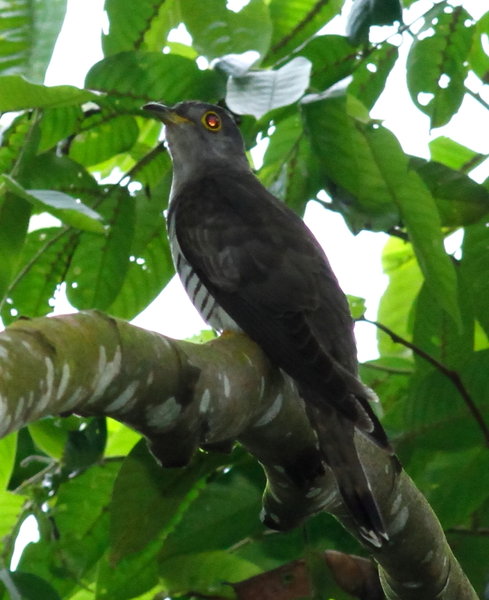
Hodgson's Hawk Cuckoo
 
The splitting of subspecies of the migratory Hodgson's Hawk Cuckoo (HHC) and Malaysian Hawk Cuckoo (MHC) has caused much confusion amongst birdwatchers in Peninsula Malaysia. Actually the differences is there when comparing mature adult birds. It is only when you want to id the immature or subadult HHC based on poor photos like mine here.

Yong Ding Li did a superb writeup on the differences of features of the birds. For the adult bird; the easy tell tale is that the HHC has rufous wash on its neck to breast (like the Large Hawk Cuckoo) whilst the MHC has a cleaner and heavy vertical streaking. The MHC also have more puffy white throat to go; see my shot at :
http://mikebirder.multiply.com/photos/album/436/Cuckoo_Malaysian_Hawk_#

A summary of visible immature features between the species are as follows:

Immature Features Comparison

a. White nape patch MCC - Present / HHC - Absent
b. Wings Fringes MCC - Pale whitish & faint / HHC - Buffy to Rusty
c. Innermost Tertial feathers MCC - More Brownish / HCC - Paler & very faint
d. Bands on underside primaries MCC - broader / HHC - Less broad
e. Underparts MCC - Whiter & cleaner / HHC Rufous orangy wash
f. Plumage Color MCC - Darker Brown / HHC lighter and true brown

Further to that timing of sighting of the HHC should be during the period between the coming of northern wintering period initiate the migratory period starting as early as October and the arrival of Spring/Summer call for the return trip back to northern hemisphere as late as May of the year. Another fact is according to Craig Robson's bird guide MHC is a resident lowland bird and seldom go higher than 500m whilst the HHC prefers the cooler coastal lowland to highland upto 1500m.


CUCKOO 6/14 - Large Hawk Cuckoo

 Large Hawk Cuckoo

Still hunting for my elusive Speckled Piculet last weekend in the month Oct 2011. Instead got 2 lifers. One of them is this large bird of 15 inches or 40cm at the Telekom loop left of the junction.

Large Hawk Cuckoo is found in Bangladesh, Bhutan, Cambodia, China, India, Indonesia, Laos, Malaysia, Myanmar, Nepal, Pakistan, the Philippines, Singapore, Taiwan, Thailand, and Vietnam. The resident subspecies of the Malay Peninsula, Sumatra and Borneo is sometimes considered a separate species, the Dark Hawk-cuckoo (C. s. bocki ). It feeds on insects, mainly caterpillars, spiders, birds eggs and berries. In Peninsula they can be seen at highland tropical forests at altitude upto 2,500m like Fraser's Hill. LHC can also be seen in Awana side but may be the migrant ones.

It has a greyish-brown back, a grey head and a tail with broad bars. The throat is white and the breast is rufous and both have dark streaks. The belly has broad black bands on white. The eyering is yellow and the iris is orange to buff in colour.

It is a brood parasite and its hosts tend to be Laughingthrush, Barwings and similar. Its scientific specific name sparverioides means "resembling a Sparrowhawk" and, in flight, it looks just like a Sparrowhawk. It is possible that this may cause potential hosts to flee allowing the Large Hawk-cuckoo to lay its eggs.


CUCKOO 5/14 - Malaysian Hawk Cuckoo


Malaysian Hawk Cuckoo

Keeping pace with Madi I got the Malaysia Hawk Cuckoo in the deep side of Kemensah Hill whilst waiting for bird wave. The bugger just flew out and perch on a branch of the large tree in the ravine. Against the glaring background I only manage poor shot. The distance from Madi catch and mine is about 3 klicks. Comparing the birds It is unlikely the same bird though cuckoo do move around. Mine looks like a juvenile.

This is a resident of Malaysia wherelse there is another subspecies Hodgson's Hawk Cuckoo which winter over here from China - Nepal side. Similar in size and shape. The separation is the Malaysian has a cleaner black streak marking over whitish chest whilst the visitor have buffy rustic chest and the latter have darker grey overall. Both have a bit of puff throat and flatten tail. Calls is almost the same. During the same time of my sighting a Hodgson's was sighted in Singapore. Very rare to see the latter......

It is a medium size cuckoo reaching less that a foot with a flattened out tail.

CUCKOO 4/14 - Oriental Cuckoo


Oriental Cuckoo


Caught it in FRIM Kepong during a rainy morning. With its greyish coat and clear barred white chest The Indian Cuckoo have a more brownish and distinct coat.

The other two photos inbetween here; are the Hepatic breed I can only deduce that cuckoo with yellow eye ring is this two. This shots were taken at Rimba Kemensah a week after the Banded Bay Cuckoo was sighted at the same spot.

CUCKOO 3/14 - Plaintive Cuckoo

Plaintive cuckoo

 
The Plaintiff frequent the open ground and perched on dead stumps, post and fences on lowland and jungle fringes. The closest u can approach them is about 30-40 ft if you walk slowly and zig zagging to it. They will just fly off to a similar distance from where you started off.

It is the size of a pigeon with a greying head, red eyed with a beautiful tail and chestnut winged. Last seen in TRA. It is seasonal traveller and not local to an area.


Wednesday, 24 October 2012

PARROT 4/5 - Blue-rumped Parrot

Blue-rumped Parrot
 
It is found in lowland forests, generally below 700m, in forest, open woodland, orchards and plantations, mangroves, dense scrub, and coconut groves. It occurs in flocks up to 20 birds. They eat seeds, fruit and blossoms.

This small parrot - averaging 7 inches or 18 cm in length - is primarily green, with bright red shoulder patches, and yellowish margins on the wing coverts.

The male has a black mantle, red upper mandible, and greyish-blue head and rump, with a brighter blue to the forehead and crown. The breast and abdomen are greyish-olive. The thighs and under tail-coverts greenish-yellow with bluish tips. The back is blue-black with each feather edged greenish-grey. The lower back and upper tail-coverts are deep blue. The sides of the body and the wing-coverts and bend of wing are red. The outermost lesser wing-coverts are brownish-red. The wings and greater wing-coverts are dark green. The secondaries and wing-coverts have a greenish-yellow edging. The upperside of the tail-feathers are greenish-yellow and the underside is yellow. The upper mandible of the male is red and his lower mandible is brown-blackish. The irises are pale yellow and the feet are grey.

It is common caged bird with similar fate of the Blue crowned hanging parrot. It is getting rare to see them in the wild in Malaysia.


PARROT 3/5 - Blue-crowned Hanging Parrot


Got to shoot  a pair  of this parrot at Old Gombak road Dec 2023. Shooting against harsh sky at a distance of 30-40 ft or so.


Blue-crowned Hanging Parrot