Followers Do tag here to follow my latest posting

MikeBirder - Malaysian Birds

Hi

Welcome to my Malaysian Birding Blog. I migrated to blogspot.com as my blog at multiply.com closed shop in 2012. I wish to showcase all Malaysian birds that I have photographed whether here or overseas. My countdown of lifers started in 2005. Coming into October 2026 my countdown of lifers photograph has reached
604/688 species of birds of Malaysia in photos.

My shooting gear was a EF400mm f4 DO lens and Canon 7D body which to me is the ideal setup for mobility and bird chasing at that time. Eventhen the weight over my shoulder is more that 5.5 kg. As of June 2016 I have also acquired a Fuji XF 100-400mm OIS lens to complement my travelling cum birding trip overseas. My Fuji X-T2 went kaput recently and I upgraded to the X-T5 in 2023 ; the weight over my shoulder is much lighter now by 30%. In December 2018 I acquired the Nikon Coolpix P1000 as supplementary camera for distance shooting of 3000mm.
Fuji have finally made available their new XF 200-600mm lens which I yet to decide to spend another RM10,000. As for Fuji body I will stop with X-T5 36megapixel ..........

I am a weekend birder. Do feel free to drop me a line at mikebirding@gmail.com and I see whether you can tag along in my outings. My usual day trip is just an hour ride away to Hulu Langat, Lancang, Kemensah, Krau, Awana, Hulu Kali, Gombak Ole Road, Fraser's Hill , Bukit Tinggi and KSNP & Coastal Sg Janggut Jeram side of the coast . Overnite trip to Merapoh & Amp; Cameron, Air Hitam and further north to Kuala Sidim is a seldom affair but for lifer we travel. Panti in Johor is another good birding site that I yet to go. Then there are the Borneo birds of Sabah and Sarawak of Malaysia which I seriously much go to chalk up more lifers. This I did in 2018 to Sepilok Sandakan and Kinabalu Park. Next Danum and LahatDatu . In 2024 I visited a new happening birding spot in Talang Seremban.......

WARNING Birding is an addiction once you started its hard to stop. The wifey and children are now birding widow and orphan.

ALL PHOTOS IN THIS BLOG ARE COPYRIGHT OF MIKEBIRDER. KINDLY SEEK PERMISSION FROM THE OWNER IF YOU want to use them for commercial purposes.

Translate

Search for Malaysian Bird Photos

Sunday, 3 February 2013

DUCK 3/15 - Cotton Pygmy Goose

Cotton Pygmy Goose

Small individuals of this species are the smallest waterfowl on earth, at as little as 160 g (5.6 oz) and 26 cm (10 in). White predominates in this bird's plumage. Bill short, deep at base, and goose-like.

Male in breeding plumage is glossy blackish green crown, with white head, neck, and underparts; a prominent black collar and white wing-bar. Rounded head and short legs. In flight, the wings are green with a white band, making the male conspicuous even amongst the huge flying flocks of the Lesser Whistling Duck, which share the habitat. Female paler, without either black collar and only a narrow or nonexistent strip of white wing-bar. In non-breeding plumage (eclipse) male resembles female except for his white wing-bar. Flocks on water bodies (jheels), etc. The call is a peculiar clucking, uttered in flight.

Its food is chiefly seeds and vegetable matter, especially water lilies; also insects, crustaceans, etc. In peninsula Malaysia; common sighting are in pond infested with water weeds in ponds stretching from Malim Nawar to Batu Gajah, Perak.


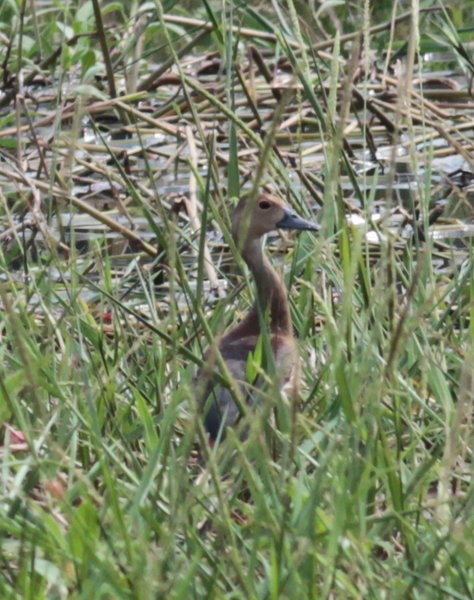


DUCK 2/15 - Lesser Whistling Duck


 Lesser Whistling Duck

Lesser Whistling Duck are usually gregarious. They feed mainly on plants taken from the water as well as grains from cultivated rice apart from small fish, frogs and invertebrates such as molluscs and worms.They dabble as well as dive in water. They will often waddle on the land and Common Mynas have been noted to follow them on grass.

This is a largely resident species distributed widely across lowland wetlands of the Indian Subcontinent and Southeast Asia. They also occur on islands in the region including the Andamans, Nicobars and Maldives. To see them you have to go to Kinta Bird Santuary Bt Gajah.

Courtship involves the male facing the female and dipping and raising its bill in the water and swimming around the female. They breed during the monsoon or rainy season and may vary locally in relation to the food availability. The nest site may be a tree hole lined with twigs and grass or built in the fork of large tree, sometimes reusing and old nest of a kite or heron or even on the ground. The clutch varies from 7 to 12 white eggs that are incubated by both the parents. Large clutches of up to 17 have been noted  although these may be indications of intraspecific brood parasitism. The eggs hatch after about 22-24 days. More than one brood may be raised in a single season. Young birds may sometimes be carried on the back of the parents.


DUCK 1/15 - Tufted Duck

Tufted Duck

The adult male is all black except for white flanks and a blue-grey bill. It has an obvious head tuft that gives the species its name. The adult female is brown with paler flanks, and is more easily confused with other diving ducks. In particular, some have white around the bill base which resembles the scaup species, although the white is never as extensive as in those ducks.

Their breeding habitat is close to marshes and lakes with plenty of vegetation to conceal the nest. They are also found on coastal lagoons, the seashore, and sheltered ponds of Eurasia US and Canada. They are migratory mainly to milder Europe and  Southern part of Asia .For  Malaysia it is a vagrant and if  it  land in Malaysia you take the earliest opportunity to make acquintance if not you have to wait another umpteen years. I must say 2013 sure is a good year for the local birding fraternity..................

These birds feed mainly by diving, but they will dabble. They eat molluscs, aquatic insects and some plants and sometimes feed at night.

Wednesday, 16 January 2013

KOEL 1/1 - Common Koel

Common Koel

They are majestic bird with their unique echoing wooo..rrh call repeatative like gibbon. They are parasitic like their cousin cuckoos meaning they lay their eggs on other bird nest and the adopted parent feed them till they can fly away. They feed on wild fruits like the ficus and grub they can find. Yet to witness Koels eating road kills though like crows

In the 80s, some work was done by the faculty of biology, USM, on
parasitic cuckoos and their host preferences. The main hosts for koels were
crows and common mynas. Conclusions were that the koels do not show
preference for which crow or which myna species. However, one
under-graduate thesis showed a distinct preference for large-billed crow
nests, at least in the Minden / Gelugor area. At that time, large-billed
were much more common than present. As for common myna, its probably coz of their nesting habits - Chinese crested and Jungle tend to nest in banks rather than trees and roof eaves.

In Sarawak,Tony Sebastian tracked the spread of common & white-vented for some years now, and its only with the advent of mynas have the Koel's population proliferated in urban areas - there are no crows in east Malaysia. Prior to the mid-80s, koels were rare jungle birds and winter visitors to the coast and islands - now they are everywhere in towns.


MUNIA 4/5 - White-rumped Munia


White-rumped Munia

This Munia can be said a hybrid of the scaly & black-headed cousin. It is found commonly in jungle fringes with grassland and cultivation feeding on lallang seeds.

Now to look for the introduced Javan Munia 5/5 in  Muar Johor. It will be long wait for tehm to move to central peninsula...........

MUNIA 3/5 - White Headed Munia


White headed Munia
Well it is just the opposite of the Black headed. They are found foraging togehter with the other Munia in open grassland and marshland of the coastal areas of peninsula Malaysia.

MUNIA 2/5 - Scaly-breasted Munia

Scaly-breasted Munia
 
The Scaly-breasted Munia is 11–12cm in length. The adult has a stubby dark bill, brown upperparts and darker brown head. The underparts are white with black scale markings. The sexes are similar, but immature birds have pale brown upperparts, lack the darker head and have uniform buff underparts of different plummage.

The Scaly-breasted Munia is a small gregarious bird which feeds mainly on seeds. It frequents open woodland and cultivation. The nest is a large domed grass structure in a tree or under the eaves of a house into which 4–10 white eggs are laid. Nesting isvery common on palm tre