Followers Do tag here to follow my latest posting

MikeBirder - Malaysian Birds

Hi

Welcome to my Malaysian Birding Blog. I migrated to blogspot.com as my blog at multiply.com closed shop in 2012. I wish to showcase all Malaysian birds that I have photographed whether here or overseas. My countdown of lifers started in 2005. Coming into October 2026 my countdown of lifers photograph has reached
604/688 species of birds of Malaysia in photos.

My shooting gear was a EF400mm f4 DO lens and Canon 7D body which to me is the ideal setup for mobility and bird chasing at that time. Eventhen the weight over my shoulder is more that 5.5 kg. As of June 2016 I have also acquired a Fuji XF 100-400mm OIS lens to complement my travelling cum birding trip overseas. My Fuji X-T2 went kaput recently and I upgraded to the X-T5 in 2023 ; the weight over my shoulder is much lighter now by 30%. In December 2018 I acquired the Nikon Coolpix P1000 as supplementary camera for distance shooting of 3000mm.
Fuji have finally made available their new XF 200-600mm lens which I yet to decide to spend another RM10,000. As for Fuji body I will stop with X-T5 36megapixel ..........

I am a weekend birder. Do feel free to drop me a line at mikebirding@gmail.com and I see whether you can tag along in my outings. My usual day trip is just an hour ride away to Hulu Langat, Lancang, Kemensah, Krau, Awana, Hulu Kali, Gombak Ole Road, Fraser's Hill , Bukit Tinggi and KSNP & Coastal Sg Janggut Jeram side of the coast . Overnite trip to Merapoh & Amp; Cameron, Air Hitam and further north to Kuala Sidim is a seldom affair but for lifer we travel. Panti in Johor is another good birding site that I yet to go. Then there are the Borneo birds of Sabah and Sarawak of Malaysia which I seriously much go to chalk up more lifers. This I did in 2018 to Sepilok Sandakan and Kinabalu Park. Next Danum and LahatDatu . In 2024 I visited a new happening birding spot in Talang Seremban.......

WARNING Birding is an addiction once you started its hard to stop. The wifey and children are now birding widow and orphan.

ALL PHOTOS IN THIS BLOG ARE COPYRIGHT OF MIKEBIRDER. KINDLY SEEK PERMISSION FROM THE OWNER IF YOU want to use them for commercial purposes.

Translate

Search for Malaysian Bird Photos

Friday, 19 October 2012

BABBLER 22/23 - Abbott's Babbler


Calling my Sifus....Horsfield's, Abbot's or Short tailed..................in the end compared the call recorded by Sifu Khong's its a Abbot's Babbler alrite...... a lifer still. Size about 16.5cm or 7 inches Very broad looking pale whitish chest with rufous vented and side. I have seen pictures by others the belly and chest can turn orangy too.

During my encounter it stays in one tree for a long period of half an hour. Unlike other babblers it tend to sit out on open branches. It continuous give out a three syllable clear sharp call which I recorded .....will attach later. Occasionally It will drop onto the ground and slowly climb up the tree upto 15 ft high. You notice the photos are top up. The bird was on its own. No mate yet for the breeding season. Apparently the nesting period of Abbott's Babbler can starts as early in late January until September as recorded in Thailand. Can also be sighted in KSNP and Taman Negara

The Abbott's Babbler (Malacocincla abbotti) is a SEA bird in the Timaliidae family as it is found in Bangladesh, Bhutan, Cambodia, India, Indonesia, Laos, Malaysia, Myanmar, Nepal, Singapore, Thailand, and Vietnam.

The name of the species commemorates William Louis Abbott (1860-1936), American naturalist and collector, who studied the wildlife of the Indo-Malayan region.


BABBLER 20/23 - Puff-throated Babbler


Puff-throated Babbler
 
The Puff-throated Babbler or Spotted Babbler is a species of passerine bird found in Asian region with population variations has led to nearly thirty subspecies being described. In Malaysia it is found in the northern peninsula from Perak upto Perlis. They are found in scrub and moist forest mainly upto 1,800m of hilly regions. It can be heard and seen at plantation fringes. I got my lifer near a rubber estate enroute to Bukit Wang forest reserve. For the matter I got detoured from NS highway exiting early to Kuala Nerang. Then heard the familiar loud and distinct call of the BTB whilst slowing down at a T-junction. It took me almost an hour to locate one of them. Just lucky it turn out that way.

Puff-throated Babblers vocalize often. Their calls are a series of whistling notes ascending in scale - the common call "wi-chu" or "wi-ti -chu" The calling can be persistent. Their repetiore include their morning song, contact and alarm calls so you should have the right playback to lure it out from the undergrowth.


They are gregarious and forage in small groups on the forest floor, turning around leaf litter to find their prey and usually staying low in the undergrowth where they can be hard to spot. Puff-throated Babblers have strong legs, and spend a lot of time on the forest floor. They have weak flight because of their rounded short wings. They can often be seen creeping through undergrowth in search of their insect food, looking at first glance like a Song Thrush. It is considered a common babbler in peninsula.

The breeding season is mainly during the rainy season. They build a nest on the ground at the base of bush and is a dome of leaves and twigs with an entrance on the side. The opening usually pointing downhill when the nest is on slopy ground. The clutch varies from 2 to 5 eggs, with northern populations tending towards larger clutches. Parent birds run rodent-like in the undergrowth as they move in and out of the nest. Young birds fledge and leave the nest about 12 to 13 days after hatching.

Other recorded sighting is at Gunung Jerai Kulim and Kuala Kangsar. Just listen for its call.......good luck. I now need to find my last babbler Grey-breasted Babbler...................


BABBLER 21/23 - Grey-throated Babbler

Grey-throated Babbler
Species of Babblers are the most diverse in features to which without good photos it will be guess work and a task to identify. This is made worse when they keep in the undergrowth playing hide and seek and peekaboo with you.

The Grey-Throated is no exception when I encountered it together with the Dark-necked Tailorbird at Awana. Jason id it in an instant of its streaky forehead and grey with white patch throat. Size slightly bigger than the tailorbird....5 inches or so and keep to the lower storey

BABBLER 19/23 - Chestnut-rumped Babbler

Chestnut-rumped Babbler
 
One of the larger babbler about 7-8 in long in peninsula Malaysia's lowland forest and southern Thailand. Seldom seen but commonly heard. Like many other babbler they are communion and forage in group od 3-5 birds at low storey and at times drop onto the ground in search of grubs and crawlies.

It got this blue spectacle rim and black straited breast which is very distinct. And of cos the rump and tail is chestnut in colour. You also will notice its eyes are pale yellow


Thursday, 18 October 2012

BABBLER 18/243 - Black-capped Babbler

 Black-capped Babbler

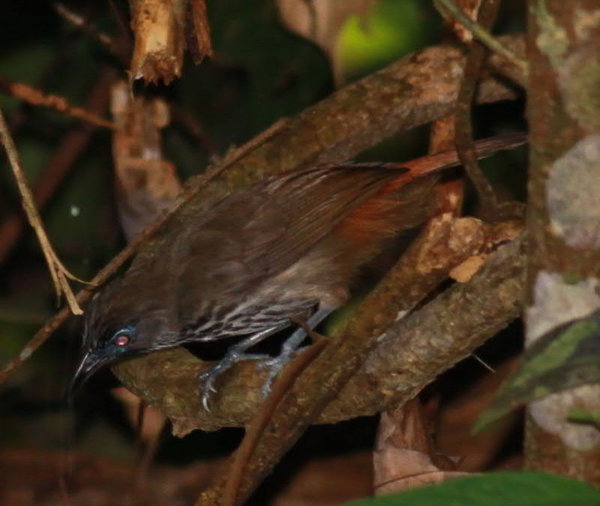
A lifer for the afternoon outing on Sunday. Black-capped Babbler is an uncommon listed bird. Found this one at small creek off the Kampung Kemensah. Birds were aplenty and suddenly pop out this bird about 40 ft away It was ready to scoot whilst I snap away from my position.....dare not get close but alas picture too far to be sharp......


New photos taken at Merapoh Taman Negara in May2015 . Courting underway as the Male offering mealworms which other birders scattered at the feeding station.

BABBLER 17/23 - Black-throated Babbler

Black-throated Babbler
Dreaming of catching this uncommon babbler ever since Madi shoot his in Bentong and Yen in Sg Koh Taman Negara. I finally got mine in Bkt Lancang Pahang. It is a resident of peninsula of Malaysia and southern side of Thailand. Sorry guys in Singapore this babbler dah lesap....maybe in Panti Johor

I must say it is a beautiful crooner like the fluffy-backed tit babbler. I got a video but blurred out.... sigh. This pair accompanied me for a good stretch of the trail but keep to the undergrowth. No clear shots but I am happy with what I got.

Its features are very distinct with white patches to cheek and brow. Its crown is also streaked. Dark throated with a white neck lace across its chest. Size wise just about 6 inches or 15cm. They start breeding in the months of May-July of the year. They are lowland birds keeping to evergreen and swampy forest upto about 500m sea level. Black-throated Babblers do comes down to lower storey to feed on grubs and invertebrates, berries and fruits as well as nectar when food are wanting.

Now to get Puff-throated in Gunung Jerai; Scaly-crowned & White-necked in Tmn Negara.


Revisited Bukit Rengit in June 2016 and manged some better shots of the  bird as below;-


BABBLER 16/23 - Buff-breasted Babbler

Latest Catch June2016 Jelai Frasers Hill
Buff-breasted Babbler
It is listed as a common babbler in Peninsula. After knowing its call I only realised it is indeed a common babbler as I can hear it calling along the stretch before the Bkt Rengit - Deerland (and along the green dense forest fringes there onwards) whenever I drive pass thinking what is calling. This is in the early part of the morning.

The Buff-breasted Babbler (Trichastoma tickelli) is a species of bird in the Timaliidae family. Small about 14cm or 5.5inches in length. The matured bird will have fine black streak buff breast. My shots were a bit soft due to poor lighting. The Juve was without a tail and I earlier thought it was a Short-tailed Bab. It call out in response to my Large Wren playback. The Chestnut-winged also was calling nearby. It stayed mainly at the lower storey of the jungle. It's diet is mainly insects and grubs that they find on ground and low shrubs' branches.

It is found in Bangladesh, Cambodia, China, India, Laos, Malaysia, Myanmar, Thailand, and Vietnam. Its natural habitats are subtropical or tropical moist lowland forests (Krau, Panti) and moist montane forests upto 1,500m (like Fraser's). They usually start breeding and nesting in the months of Feb-Jul. their nest is cuplike and often on the ground under foliage or branches just 1.5 ft from the ground. Should be easy to find..................?


Beautiful capture of the buff-breasted in Bukit Tinggi  November 2015.